
There are some moments in grief that sneak up on you.
You think you are doing one thing.
Dropping off a child.
Helping them adjust to a new environment.
Trying to keep a situation calm.
Trying to encourage bravery in a little one who is already struggling with fear, anxiety, and big questions about life and death.
And then suddenly, grief steps into the room.
Not quietly.
Not politely.
Not at a convenient time.
Just right there in front of everyone, like grief tends to do when it has absolutely no respect for schedules, crowds, children’s activities, or the fact that you were really hoping to hold yourself together that day.
Recently, I found myself in one of those moments.
One of our kids has been going through a season of big fears. The kind of fears that may not always make sense to adults (heaven help us), but feel very real to them. 🤪
Fear that food has spoiled within minutes.
Fear of suddenly developing a serious illness.
Fear of throwing up.
Fear of getting hurt.
Fear that I will die if they are not right beside me.
Fear that Dad got lost on the way home.
Fear after fear after fear.
If you have loved a child through anxiety, you know how exhausting and tender it can be. You know the careful dance of comforting them without feeding the fear. Staying close enough to reassure them, but slowly stepping back enough to help them learn they are safe.
And when grief is part of a family’s story, children process death in their own time. Sometimes it comes later. Sometimes it comes sideways. Sometimes it shows up as questions, clinginess, panic, stomachaches, or worries that seem to multiply overnight.
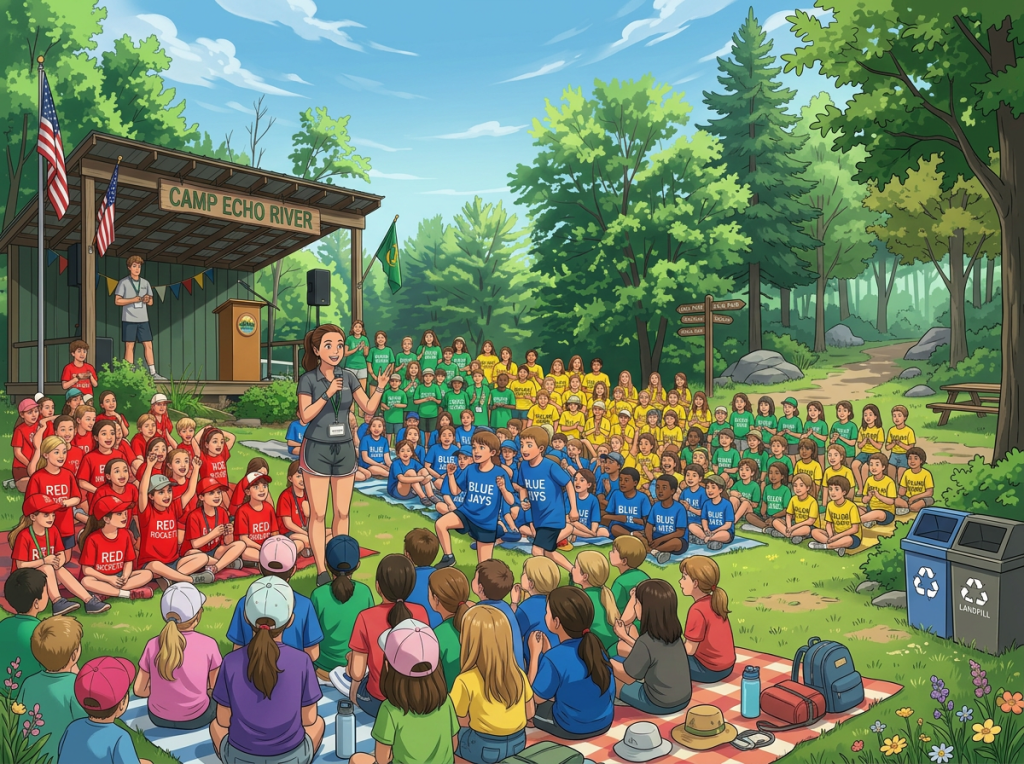
So on this particular day, in a busy setting full of little kids, big kids, noise, music, activities, and all the beautiful chaos that comes when adults are trying to organize kids and summer camp-my daughter struggled.
It was not shocking. (But still stressful)
It was not the end of the world.
It was a first-day kind of fear.
We were working through it. (Even if I was growing weary 🥺)
People who needed to know were aware that my kiddo was having a hard time. The camp leader knew. I was gradually helping my child settle in with their new group. We had made it through the first part of the day. They had even participated some!
Then it was time to move into another activity, and I was trying to help my child face forward, listen, and slowly separate from needing me right beside them.
It was one of those mama bird moments.
The baby bird is wobbling on the edge of the nest.
You are whispering, “You can do this.”
You are slowly backing away.
You are trying not to make too much eye contact because everyone knows children can smell parental weakness.
And then everything shifted.
When a Hard Conversation Happens in the Wrong Moment
I was pulled aside for a conversation.
At first, I was confused. I was asked if I was supposed to be at the camp, if I was volunteering, or if I needed to leave.
I tried to explain that I was not trying to interfere. I was helping my child through anxiety so drop-off could become calm instead of turning into a full meltdown. I was trying to avoid disruption, not create one.
I knew that once my kiddo got involved, they would probably be fine. Tomorrow would likely be easier. The first day was simply hard.
But the conversation felt cold.
The tone felt sharp.
And instead of feeling helped, I felt cornered.
Then came the comment that landed hard:
Was my child even going to participate, or were they just going to stand there?
And maybe to someone else, that question would not have hit the way it hit me.
But when you are already managing a child’s anxiety, trying to protect children in close proximity of your child from an emotional blow-up, plus carrying your own history of trauma and loss…tone matters.
Timing matters.
Compassion matters.
I tried to explain again that we were working with my child. That others were aware. That I was trying to help the situation go smoothly.
Eventually, I said I could help if that was what needed to happen. I was willing. I did not mind helping. But then something inside me cracked.
Because suddenly, my mind went back.
Back to another time I had been involved in kids camps.
Back to my nerves then.
Back to my sons.
Back to Garet.
Back to the reality that he is not here anymore.
And there I was, surrounded by children, trying to explain through tears that after losing my son, I did not know if I could handle certain roles with kids right now. I wasn’t sure if I would be triggered by the camp activities I once did with Garet.
I was trying to get the words out.
Trying not to sob.
Trying not to make a scene.
Trying not to fall apart in a place where everyone else was just trying to get through the morning and create some memories for these kids.
And then I was asked how he died.
Right there.
In that moment.
With people nearby.
With children around.
With me already crying.
In the middle of a tense conversation.
And I froze inside.
Some Questions Need Gentleness
I am open about Garet.
I do not hide that I lost my son.
I do not hide that he died from an overdose.
I do not hide that I found him.
I do not hide because I loved Garet then, and I love him still. I can promise that he did not plan his addiction, and he hated that it became his struggle.
I share because I believe these conversations matter. I share because addiction, fentanyl, grief, trauma, and child loss are topics we need to stop hiding in dark corners. I share because awareness matters. I share because silence can make grieving people feel even more alone. I share because I am a grief coach, and I can understand your pain as a parent.
But being open does not mean every moment is the right moment.
Being willing to talk does not mean I am ready to answer deeply painful questions in the middle of an already emotional public situation.
Being honest about loss does not mean people are entitled to details before checking whether my heart can handle that question right then.
And that is the point I keep coming back to.
The question itself was not necessarily wrong.
The timing was.
The setting was.
The tone was.
At least, that is how it felt in my body.
And when you are talking to someone about the death of their child, their spouse, their parent, their sibling, their friend, or anyone they deeply loved, the way you ask matters.
A lot.
Curiosity Is Not the Same as Caring
I want to say this gently but clearly:
Not every question is compassionate just because it is personal.
Sometimes people ask because they care.
Sometimes people ask because they do not know what else to say.
Sometimes people ask because they want to understand.
But sometimes, even unintentionally, a question can feel like curiosity instead of care.
It can feel like someone is reaching for details before they have reached for the person.
That matters.
Because grief is not a headline.
It’s not gossip.
It’s not a dramatic story to satisfy someone’s curiosity.
It is someone’s life.
Someone’s child.
Someone’s wound.
Someone’s before and after.
When someone tells you they lost a loved one, especially a child, that is holy ground.
Please step carefully.
Ask Permission Before Asking for Details
Some grieving people want to talk about what happened.
Some do not.
Some will talk about it in time.
Some may answer one day and not be able to answer the next.
Some may be comfortable sharing in private but not in public.
Some may talk openly because they are trying to spread awareness.
Some may still carry fear of being judged, especially when the loss involved overdose, suicide, addiction, mental health, violence, estrangement, or circumstances others may not understand.
So before asking, “How did they die?” maybe ask something softer.
Try:
“Do you feel comfortable talking about what happened?”
Or:
“You do not have to answer this, but would you want to share more about them?”
Or:
“I am so sorry. I do not want to ask anything painful, but I am here if you ever want to talk.”
Or simply:
“I am so sorry. What was their name?”
That last one matters.
Sometimes the kindest thing you can ask is not how they died.
It is who they were.
Read the Room
There is a time and place for deeper conversations.
A crowded public setting may not be that place.
A moment when someone is already crying may not be that moment.
A tense conversation may not be the safest doorway into someone’s deepest trauma.
A busy children’s event may not be where a grieving parent can calmly explain the worst day of their life.
This does not mean we should avoid grieving people.
Please do not hear that.
Grieving people do not need everyone to walk on eggshells and act like they are made of glass. We need kindness. We need honesty. We need people who are willing to say their name, acknowledge the loss, and not disappear because things feel uncomfortable.
But there is a difference between being present and being invasive.
There is a difference between care and pressure.
There is a difference between asking and demanding emotional access.
And sometimes the most loving thing you can do is pause long enough to notice the person in front of you.
Are they already overwhelmed?
Are they in public?
Are their children nearby?
Are they trying not to fall apart?
Is this a safe moment?
Could this question wait?
That pause can protect someone’s heart. ❤️🩹
Parents Carry More Than You See
I also want to speak for the parents trying to help anxious children through hard things. Including delayed grief.
Sometimes what looks like a child “not participating” is actually a child trying very hard not to panic while trying to have fun.
Sometimes what looks like a parent hovering is actually a parent slowly helping their child build courage.
Sometimes what looks like overprotectiveness is actually a family walking through grief, trauma, anxiety, or a hard season no one fully sees.
And yes, children still need boundaries. Mine included.
They still need encouragement.
They still need to learn independence.
They still need adults who lovingly help them do hard things.
But there is a way to support that process with compassion.
There is a way to ask questions without shame.
There is a way to say, “How can we help her/him feel comfortable?” instead of making the parent feel like a problem.
Most parents are not trying to make things harder. We really aren’t.
Most are trying to prevent the explosion before everyone else hears it (and it activates a chain reaction. 😲😁)
Most are doing the invisible work of helping a child feel safe enough to try joining in.
And sometimes they are doing that while carrying their own grief too.
Grief Does Not Always Stay in Its Lane
One of the hardest things about grief is that it does not stay neatly tucked away until a “better time.”
It can come up during a song.
A smell.
A holiday.
A child’s activity.
A question.
A tone of voice.
A role you used to do before the loss.
A cabin full of campers.
A moment where you are trying to be strong for the child standing in front of you, and suddenly the child who is gone from earth is right there in your heart too.
That is grief.
It connects things.
It wakes up memories.
It pulls old pain into new moments.
And sometimes, even years later, you find yourself crying in a place where you really did not want to cry.
That does not mean you are weak.
It means the love is still there.
It means the wound can still be touched.
It means you are human.
What I Wish Had Happened
I have thought about what would have helped in that moment.
Not perfection.
Not a long emotional counseling session.
Just gentleness.
Maybe something like:
“Hey, I see s/he is struggling. Can you tell me what s/he needs?”
Or:
“Is there a plan we can help with so she can participate?”
Or:
“I know this is hard. Let’s work together for a few minutes and see if we can get him settled.”
And later, if my grief came up:
“I am so sorry about your son. You do not have to talk about it here, but I am sorry.”
That would have been enough.
Sometimes kindness does not need to be complicated.
Sometimes it is just tone.
Timing.
A softer question.
A little dignity.
A little room to breathe.
A Gentle Reminder for All of Us
The truth is, all of us will get this wrong sometimes.
We will say the awkward thing. (I am so very awkward!)
Ask too quickly.
Miss the cue.
Speak from stress instead of compassion.
I know I have. (And, unfortunately, I am sure I will do it again.)
This post is not about shaming anyone for being imperfect. We are all human. We all have moments where we handle things badly, especially when we are busy, overwhelmed, responsible for a lot, or trying to keep a situation under control. (I respect it. I would not want to run a summer camp! That is some hard work!)
But maybe we can learn.
Maybe we can become more aware.
Maybe we can remember that behind every person is a story we may not fully know.
The parent who seems anxious may be carrying trauma.
The child who will not separate may be processing death.
The person who suddenly cries may have just been pulled back into a memory they were not prepared for.
The one who answers sharply may not be rude. They may be trying not to break.
And the person standing in front of us may need compassion before correction.
When Someone Shares a Loss
If someone tells you they lost someone, especially if the loss is traumatic, try to slow down.
You do not have to fix it. There is no way to fix it.
You do not have to have the perfect response.
You do not have to ask for details.
You can simply say:
“I am so sorry.”
“What was their name?”
“I cannot imagine how hard that is.”
“Thank you for trusting me with that.”
“Do you want to talk about it, or would you rather not right now?”
“I am here with you.”
Those words may seem small.
But in a vulnerable moment, small kindness can feel like shelter.
Closing Reflection
Maybe the lesson is this:
Before we ask the question, read the room.
Before we seek the details, see the person.
Before we correct the behavior, consider the story.
Before we assume a child is being difficult, remember they may be afraid.
Before we assume a parent is hovering, remember they may be holding a fragile situation together with both hands and a prayer.
And before we ask how someone died, maybe we first honor that they lived.
Say their name.
Make space.
Ask gently.
Let the grieving person lead.
Because loss is not a simple conversation.
It is sacred ground.
And when someone’s grief rises to the surface in front of us, we have a choice.
We can press harder.
Or we can soften.
I hope we learn to soften.
Love and Light,
~Mandy 💜

Leave a comment