
The Pill in Someone’s Hand May Not Be What They Think It Is
Yesterday, we talked about the people.
The sons.
The daughters.
The mothers.
The fathers.
The friends.
The human beings behind the overdose statistics.
Today we need to talk about something that I desperately wish every parent, teenager, college student, grandparent, teacher, coach, and friend understood:
Fentanyl does not always arrive looking like fentanyl.
Sometimes it looks like a prescription pill.
Sometimes it looks like Xanax.
Sometimes oxycodone.
Sometimes something intended to resemble Adderall.
Sometimes it is mixed into cocaine, methamphetamine, heroin, or another substance.
And the person taking it may have absolutely no idea it is there.
The CDC warns that illegally manufactured fentanyl can be pressed into counterfeit pills or mixed into other illicit drugs, and it cannot be reliably detected by sight, smell, or taste.
That changes the conversation about drug safety tremendously.
Because sometimes the person who dies from fentanyl was not trying to take fentanyl at all.
“But It Looked Like a Real Pill”
That is exactly the problem.
Counterfeit pills are deliberately manufactured to resemble legitimate prescription medications.
The color can look right.
The shape can look right.
The letters and numbers stamped into the pill can look right.
The packaging can even look convincing.
DEA specifically warns that you cannot determine whether a pill is legitimate simply by looking at it. The agency’s recommendation is straightforward: medications should come from a licensed pharmacy and be prescribed by a trusted healthcare professional.
That means:
A pill looking like Xanax does not prove it is Xanax.
A pill looking like oxycodone does not prove it contains pharmaceutical oxycodone.
Something your friend bought believing it was medication does not magically become safer because your friend trusts the person who sold it to them.
The danger may have entered the chain several people before it ever reached you.
And everybody along the way may believe they know what they have.
Until somebody doesn’t wake up.
This Is Not the Drug World Many of Us Grew Up With
I think this is especially important for parents around my age.
When many of us were teenagers, drugs were certainly dangerous.
People overdosed.
People became addicted.
People died.
I am not romanticizing the 80s and 90s here.
But today’s illicit drug supply contains a level of unpredictability that many parents simply did not grow up understanding.
Illegally manufactured fentanyl has spread throughout the illegal drug supply and can appear in counterfeit pills and other substances. CDC says fentanyl remains a leading driver of overdose deaths in the United States.
So when we talk to kids today, we cannot only talk about:
“Don’t become addicted.”
There is another conversation:
You may not get enough chances to become addicted.
That is brutal to write.
But it matters.
A person does not have to have a years-long substance-use disorder before fentanyl becomes dangerous.
Experimentation can be dangerous.
Taking something at a party can be dangerous.
Buying a pill online can be dangerous.
Taking something given to you by someone who honestly believes they know what it is can be dangerous.
That is not a scare tactic.
That is the drug supply we have now.
And Our Kids Do Not Know As Much As We Think They Do
This surprised me.
CDC reported in 2026 that nearly half of teenagers were unaware that counterfeit prescription pills can contain lethal amounts of illegally manufactured fentanyl. The agency also reports that from 2020 through 2024, fentanyl was involved in 75% of overdose deaths among youth ages 10–19.
That tells me we still have a huge education problem.
We adults talk about fentanyl so often that we begin assuming everybody understands it.
They don’t.
A teenager may hear:
“Fentanyl is dangerous.”
Okay.
But do they understand:
The pill you think is Xanax might contain fentanyl?
Do they know:
You cannot look at a pill and know it is real?
Do they understand:
Your friend might not be lying to you when they say they know what the pill is—and still be wrong?
Those are very different pieces of information.
Those are the conversations we need to be having.
“But My Child Doesn’t Use Drugs”
Good.
I genuinely hope they never do.
Talk to them anyway.
This conversation is not an accusation.
It is education.
Your child may never take a pill.
But maybe the person sitting beside them at a party does.
Maybe their roommate does.
Maybe their best friend does.
Maybe someone says:
“My anxiety is awful. My friend has Xanax.”
Maybe somebody is exhausted studying and gets offered something they believe is Adderall and they just wanted to pass the final exam.
Maybe someone gets handed a pill at a concert.
Maybe a friend starts acting strangely afterward.
Your child knowing what fentanyl is, knowing counterfeit pills exist, and knowing that something is wrong could someday matter even if they never personally touch a drug.
We teach kids CPR without accusing them of planning a heart attack.
We teach them what to do in a fire without assuming they are going to burn the house down.
Drug education should work the same way.
Knowledge is not permission.
Knowledge is protection.
Where Did the Pill Come From?
Maybe this is one of the simplest questions we can teach.
Not:
“What does it look like?”
Not:
“Does your friend swear it is real?”
Not:
“Have they taken one before?”
Ask:
Did this medication come from a licensed pharmacy for the person taking it?
If the answer is no, you do not actually know what is in it.
That is not me being dramatic.
DEA’s current counterfeit-pill campaign specifically warns people not to trust appearance and says the only safe medications are those prescribed by a medical professional and dispensed by a licensed pharmacist.
A pill purchased through social media is not safer because the seller has cute emojis in their profile.
A pill bought online is not safe because the packaging looks professional.
A pill passed between friends is not guaranteed safe because everyone involved has good intentions.
Trusting the person is not the same thing as knowing the contents of the pill.
Four people could divide that pill. Three may live while one does not simply from careless mixing before the pill was pressed.
That distinction could save somebody.
Counterfeit Does Not Mean “Cheap Knockoff”
When I hear the word counterfeit, my brain naturally goes to fake purses.
Fake sunglasses.
Knockoff shoes.
Something that looks almost right but is probably going to fall apart in three weeks. 😂
Counterfeit medication is very different.
The problem is not simply that somebody bought fake Xanax and got a lousy imitation.
The counterfeit product can contain a completely different substance.
CDC reports that millions of fake pills are produced to resemble legitimate medications and may contain fentanyl. In drug testing cited by CDC, five out of ten counterfeit pills tested in 2024 contained a potentially deadly amount of fentanyl.
I need to be careful with that number.
That does not mean exactly half of every counterfeit pill everywhere contains a lethal amount.
It means that among the pills examined in the testing cited by CDC, approximately half contained potentially deadly fentanyl levels.
Either way?
Those are odds I never want one of my children gambling with.
Why Put Fentanyl in Something Else?
This is a question I hear often.
Why would anyone put fentanyl into another drug?
Illegally manufactured fentanyl is extremely potent, relatively inexpensive to produce, and can increase the potency of other illicit drugs. It can also be used in counterfeit pills designed to mimic prescription medications. The result is an illegal drug supply in which people cannot reliably know the strength or contents of what they are taking.
And this is why I sometimes struggle when we automatically call every fentanyl death an “overdose.”
Sometimes that word accurately describes what happened.
Sometimes a person knowingly used fentanyl.
Sometimes a person had opioid-use disorder.
But sometimes a person believed they were taking something else entirely.
Different families use different language around that.
Overdose.
Fentanyl poisoning.
Drug poisoning.
Accidental overdose.
What matters to me today is not fighting over terminology.
What matters is understanding that unknown fentanyl exposure is real.
It Is Not Only Pills
Counterfeit pills deserve special attention because they can look so familiar.
But fentanyl contamination is not limited to pills.
CDC reports that illegally manufactured fentanyl can also be mixed into drugs including heroin, cocaine, and methamphetamine.
So someone may think:
“I don’t use opioids.”
That does not necessarily mean they cannot encounter an opioid.
This is especially important for people who use cocaine or stimulants and may have little or no opioid tolerance.
They may not be expecting an opioid effect.
They may not carry naloxone.
Their friends may not recognize what is happening.
Again:
The person does not have to knowingly choose fentanyl for fentanyl to affect them.
Can Fentanyl Test Strips Help?
Yes—but they are not magic.
Fentanyl test strips can detect fentanyl in many drug samples, and CDC includes them among overdose-prevention tools. They are inexpensive and can provide results within minutes.
But there is an important limitation:
A negative test is not a guarantee that something is safe.
CDC warns that test strips may not detect some potent fentanyl-like substances, including carfentanil.
So fentanyl test strips are a harm-reduction tool.
They reduce uncertainty.
They do not transform an illicit drug into a verified pharmaceutical product.
That distinction matters.
The Illegal Drug Supply Is Still Changing
And unfortunately, fentanyl is not the end of the story.
In 2026, CDC issued a health alert about medetomidine, a veterinary sedative increasingly appearing in the illegal fentanyl supply. DEA has likewise warned that fentanyl is being found with emerging synthetic substances, making the drug supply even more unpredictable.
I am not bringing that up to pile on another thing to fear.
I am bringing this up because this is why our education has to change as quickly as the drug supply changes.
The information many of us learned twenty years ago is no longer enough.
Frankly, some information from five years ago is no longer enough!
We have to keep learning.
So What Do We Tell Our Kids?
I do not think the conversation has to be an hour-long lecture.
Actually, please don’t make it an hour-long lecture.
You will lose them somewhere around minute four. 😂
Try this instead:
“Hey, I learned something I didn’t realize about counterfeit pills.”
Then tell them.
You can say:
“A pill can look exactly like prescription medication and still contain fentanyl.”
“You cannot tell by looking at it.”
“If medication did not come from a pharmacy for you, please do not assume you know what is in it.”
And then say the part I think matters most:
“If you ever take something and get scared, call me. I want you alive more than I want you afraid of getting in trouble.”
That does not mean there will never be consequences.
It means consequences can wait until everyone is breathing.
Tell Them to Help Their Friends Too
This conversation should not stop at:
“Don’t take pills.”
I want our kids to know:
If your friend becomes extremely sleepy after taking something…
If you cannot wake them…
If their breathing becomes slow or stops…
If something feels very wrong…
Do not leave them alone because you are scared of getting caught.
Get help.
Call 911.
Find naloxone.
Stay with them!
Tomorrow we are going to talk much more about naloxone—Narcan—and why I think more ordinary people should carry it.
But today I want our kids to understand one thing:
Keeping your friend alive is more important than protecting the party from getting busted.
Every. Single. Time.
One Pill Can Change an Entire Family
DEA calls its counterfeit-pill campaign One Pill Can Kill.
I wish that phrase felt exaggerated.
It doesn’t.
As of August 17, 2026, DEA reports that its fentanyl seizures this year represent more than 239 million potentially deadly doses, including more than 21 million fentanyl pills seized.
That is an enormous illegal market.
But even that number is almost impossible to really understand.
So bring it back down to one.
One pill.
One teenager.
One college student.
One experiment.
One friend who says:
“It’s fine. I’ve taken these before.”
One parent who has absolutely no idea what their child is doing that evening.
One phone call.
One bedroom that suddenly stays exactly the way it was left.
One family learning an entirely new definition of before and after.
That is why we are talking about this.
Not to Scare Them. To Equip Them. 💜
I do not want my kids living terrified of the world.
I want them informed enough to move through it.
Those are different things.
I want them to understand risk.
I want them to know when something is unsafe.
I want them to recognize when a friend needs help.
I want them to call me.
I want them to call 911.
I want them to understand that one bad decision does not mean they deserve a bad ending.
And I want parents to stop believing that talking about fentanyl somehow plants the idea of drugs into children’s minds.
They already live in a world where fentanyl exists.
We are not introducing them to the danger.
We are introducing them to information that may help them survive it.
Today’s Conversation 💬
Tonight, ask someone you love:
“Did you know that a fake prescription pill can look almost identical to a real one?”
Then ask:
“If somebody gave you a pill, how would you know where it actually came from?”
Do not immediately correct them.
Listen first.
See what they know.
You may be surprised.
And if you are talking with your child, end with this:
“If you ever find yourself in trouble involving drugs, call me. We will handle everything else after I know you are safe.”
Say it even if you think they will never need it.
Hopefully, they never will.
But sometimes the sentences we hope our children never need are the most important ones to make sure they have heard.
Love and Light,
~Mandy💜
Day 2 — Fentanyl Doesn’t Always Look Like Fentanyl
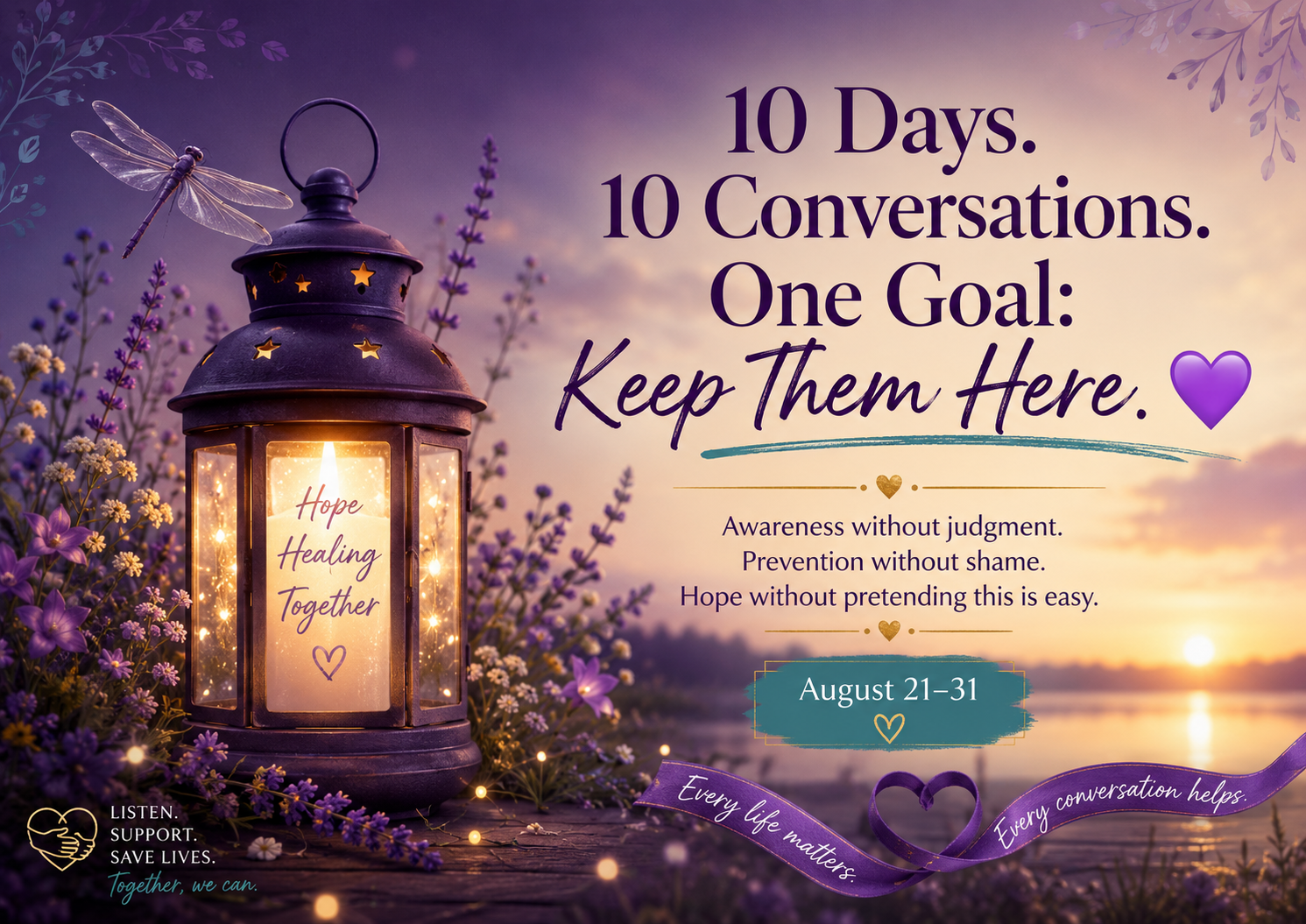
10 Days. 10 Conversations. One Goal: Keep Them Here. 💜
Awareness without judgment.
Prevention without shame.
Hope without pretending this is easy.
Tomorrow — Day 3
Narcan Gives Tomorrow a Chance
We are going to talk about what naloxone actually does, what it does not do, why giving it to someone who is not experiencing an opioid overdose will not cause an opioid overdose, and the argument I hear far too often:
“Doesn’t Narcan just enable people to keep using?”
I have some feelings about that one. 😉
Because recovery requires one thing before anything else:
The person has to still be alive. 💜
Sources & Further Reading
Centers for Disease Control and Prevention (CDC) — Information about illegally manufactured fentanyl, counterfeit pills, youth fentanyl risk, fentanyl test strips, and overdose prevention.
U.S. Drug Enforcement Administration (DEA) — Current One Pill Can Kill information, counterfeit-pill guidance, and 2026 fentanyl seizure data.
CDC Health Alert Network — Current information regarding changes in the illegal fentanyl supply, including emerging substances being mixed with fentanyl.
DEA Public Safety Advisory — 2026 warning regarding fentanyl mixed with emerging synthetic substa
Leave a Reply