
They Cannot Recover If They Are Dead
Yesterday we talked about counterfeit pills and the reality that someone can encounter fentanyl without even realizing it is there.
Today we need to talk about what can happen when something goes terribly wrong.
And more importantly:
What we can do about it.
Naloxone—often known by the brand name Narcan—is a medication that can rapidly reverse an opioid overdose.
It works against opioids including heroin, prescription opioids, and fentanyl. Naloxone blocks opioid effects at receptors in the brain and can restore breathing when an opioid overdose has dangerously slowed or stopped it.
That means a tiny nasal spray sitting in a purse, backpack, glove compartment, kitchen cabinet, workplace, church, or dorm room can potentially become the difference between:
We almost lost them.
and
We did.
That is why I think more of us should carry it.
Not just “drug users.”
Not just police officers.
Not just paramedics.
Us.
Parents.
Friends.
Teachers.
Coaches.
College students.
Church leaders.
Grandparents.
Business owners.
Anyone who might someday be standing beside another human being when everything suddenly goes wrong.
First: Narcan and Naloxone Are Basically the Names You Hear Most Often
A quick vocabulary lesson because this can get confusing.
Naloxone is the medication.
Narcan is one brand of naloxone nasal spray.
There are now several FDA-approved naloxone nasal sprays available without a prescription, including over-the-counter options that can be used by people without medical training.
So when somebody says:
“Get Narcan.”
They generally mean:
Have naloxone available.
And no—you do not have to be a nurse to use it.
That is kind of the point.
What Actually Happens During an Opioid Overdose?
Opioids can suppress the part of the brain responsible for breathing.
During an overdose, breathing may become extremely slow, weak, irregular, or stop altogether.
When the brain and body stop receiving enough oxygen, brain injury and death can follow.
Naloxone temporarily pushes opioids away from their receptors and blocks their effects, allowing breathing to begin recovering.
I say temporarily for a reason.
Naloxone can wear off while the opioid is still affecting the person’s body.
That is why giving Narcan does not replace calling 911!!!
Even if someone wakes up.
Even if they sit up.
Even if they seem angry that you ruined whatever high they were experiencing.
Call 911 anyway.
The FDA warns that a person can become unconscious again after initially responding to naloxone and may require additional doses and emergency medical care.
Narcan buys time.
Emergency care still matters.
“But What If I’m Wrong?”
This is one of the things that makes naloxone such an important emergency tool.
Maybe you find someone unconscious.
You do not know what they took.
You do not know whether fentanyl was involved.
You do not know whether this is an opioid overdose at all.
Should you give naloxone?
If an overdose is suspected, CDC guidance says yes.
Naloxone will not harm someone simply because opioids were not involved. If there are no opioids in the person’s system, naloxone essentially has nothing to reverse.
So this is not a situation where you need to stand there conducting a medical investigation.
Hmm. Pinpoint pupils? Possibly. Let’s examine the evidence…
No.
Someone is not breathing normally.
You cannot wake them.
You suspect an overdose.
Give the naloxone and call 911.
We can solve the mystery afterward.
What If One Dose Doesn’t Work?
Another incredibly important thing to know:
One dose may not always be enough.
The FDA says repeat administration can be necessary, and current naloxone products instruct users to give another dose when the person does not adequately respond while waiting for emergency help. Fentanyl and other potent opioids can sometimes require additional naloxone.
This is one reason having more than one dose available matters.
It is also another reason you call 911 immediately instead of giving Narcan and assuming the emergency is over.
The goal is not simply:
Wake them up.
The goal is:
Keep oxygen moving and keep them alive until emergency medical care arrives.
“Doesn’t Narcan Just Enable Them?”
Here we go.
I knew we were eventually going to get here. 😉
I have heard versions of this argument many times:
“If people know Narcan is around, aren’t they more likely to use?”
“Why do we keep saving people who keep overdosing?”
“How many chances does someone get?”
“Doesn’t Narcan just enable addiction?”
Here is where I land:
Narcan does not treat addiction.
It does not make somebody sober.
It does not repair relationships.
It does not create motivation for recovery.
It does not erase consequences.
It does not cure opioid-use disorder.
And it does not give someone a pleasant high—FDA describes naloxone as having no abuse potential.
Its purpose during an overdose is much simpler:
Keep the person from dying.
That is it.
What happens after that may still be incredibly difficult.
They may need treatment.
They may relapse.
Their family may need boundaries.
They may refuse help.
They may go back to using.
Or maybe something changes.
Maybe not that day.
Maybe not that month.
Maybe after another treatment attempt.
Maybe after someone finally reaches them.
But there is one thing I know with absolute certainty:
Dead people do not recover.
They do not enter treatment next Tuesday.
They do not reconcile with their children next year.
They do not celebrate five years sober.
They do not become peer-support specialists.
They do not apologize to their parents.
They do not discover purpose.
They do not get another chance.
Death ends every possibility except the memories left behind.
So if Narcan gives someone another tomorrow?
Give them tomorrow.
We can deal with tomorrow when it gets here.
We Don’t Apply This Logic to Other Emergencies
Imagine somebody having a heart attack and saying:
“Well, he ate terribly for twenty years. Why keep reviving him?”
Imagine refusing to help someone injured in a motorcycle crash because:
“She knew motorcycles were dangerous.”
Imagine seeing somebody drowning and standing on shore debating whether they should have learned to swim.
Most of us would be horrified.
In an emergency, our first question is usually:
How do we keep this person alive?
Addiction should not remove someone from that basic human equation.
We can talk about responsibility later.
We can talk about treatment later.
We can talk about boundaries later.
We can talk about consequences later.
First?
Breathe.
Narcan Is Not Permission
This distinction matters.
Carrying Narcan does not mean:
“Sure, go use fentanyl.”
Teaching teenagers about Narcan does not mean:
“Don’t worry about drugs because we can always save you.”
Putting naloxone in schools, libraries, workplaces, churches, homes, and public spaces does not mean society has decided opioid use is fine.
It means we recognize that overdoses happen.
A fire extinguisher is not permission to start a fire.
A seat belt is not permission to crash your car.
CPR training does not encourage cardiac arrest.
And naloxone is not permission to overdose.
It is an emergency tool.
And Yes, They Might Wake Up Angry
This is something people should know.
If a person is physically dependent on opioids, naloxone can rapidly trigger withdrawal symptoms.
CDC says those symptoms can include anxiety, irritability, sweating, nausea, vomiting, tremors, rapid heart rate, and other unpleasant reactions. Serious adverse effects are uncommon, but the experience can be miserable.
So someone may wake up:
Confused.
Sick.
Angry.
Agitated.
And they may not greet you with:
“Thank you, dear friend, for this lifesaving intervention.”
😂
That’s okay.
You are not administering Narcan for the thank-you card.
You are administering it because they were not breathing.
Let them be mad and alive.
Alive is the important word.
Who Should Carry Naloxone?
CDC encourages people at risk of opioid overdose, as well as their friends, families, and community members, to have naloxone available. Public-health strategies increasingly include widespread community naloxone distribution because bystanders are often the people present when an overdose happens.
But after everything we discussed yesterday about unexpected fentanyl exposure, I think the circle should be even wider.
Do you have teenagers?
College-age kids?
A family member struggling with substance use?
Someone taking prescription opioids for a medical issue?
Do you work somewhere open to the public?
Volunteer with vulnerable populations?
Work with young people?
Run a church ministry?
Go to concerts?
Attend festivals?
Have friends?
Exist in America in 2026?
Okay, maybe that last one is me being a little dramatic. 😂
But truly:
You do not have to personally use drugs for Narcan to someday matter to you.
You might be the person who happens to be there.
Newark and Licking County: We Can Actually Get It Here 💜
For my local friends, this is not something you have to order from some mysterious place online and hope arrives six weeks from now.
The Licking County Health Department’s Project DAWN program distributes naloxone in our community and provides overdose education.
The department says residents can request a free naloxone kit to be mailed to them or pick one up through its Newark program. Project DAWN also teaches family members and friends how to recognize an opioid overdose and administer naloxone.
That means you can finish reading this post and actually do something.
Not someday.
Now.
Get a kit.
Learn where it is.
Tell the other adults in your house where it is.
Check the expiration date occasionally.
And please do not hide it somewhere so carefully that nobody can find it during an emergency.
“Somewhere safe” is not particularly helpful when nobody knows where somewhere is. 😉
Put It Where Life Actually Happens
Think practically.
A purse.
A backpack.
A glove compartment, while being mindful of the storage temperature listed on your specific product.
A medicine cabinet.
A workplace emergency kit.
A church first-aid area.
A dorm room.
A coach’s emergency bag.
A grandparent’s house.
Wherever it is kept:
People need to know it is there.
Because the person experiencing an overdose cannot administer naloxone to themselves.
Someone else has to recognize the emergency and act.
That means awareness among family and friends matters just as much as possession of the medication.
I Wish More Families Had It Before They Needed It
This is one of those things nobody wants to imagine needing.
I understand that.
Nobody buys a smoke detector because they are excited about the possibility of a house fire.
We prepare because sometimes terrible things happen without asking our permission first.
And one of the hardest lessons fentanyl has taught families like mine is that:
You do not get to prepare after the emergency.
Afterward is too late.
I cannot change what happened in my family.
But I can tell another family:
Have it.
Please.
Even if your child would “never.”
Even if nobody in your home uses opioids.
Even if you think the chance you will need it is incredibly small.
Let it expire untouched.
Let it sit in a drawer for years.
Let buying it turn out to have been completely unnecessary.
I hope it is.
That would be wonderful.
Because the alternative is needing it and wishing desperately that it had been there.
Naloxone Is Not the Finish Line
I want to be careful about something else.
Saving someone’s life during an overdose is not the end of the addiction conversation.
Naloxone is an emergency medication—not treatment for opioid-use disorder. Effective treatment can include medications for opioid-use disorder along with other medical, behavioral, and recovery supports.
That matters because sometimes our system becomes very good at doing this:
Overdose.
Narcan.
Emergency room.
Discharge.
Go home.
Wait.
Overdose again.
And that is exactly one of the conversations we are going to have later in this campaign.
What happens after someone survives?
How do we make that moment a doorway into treatment instead of simply another terrifying night?
Narcan gives us the opportunity.
We still have to build something on the other side.
But First, Keep Them Here 💜
Maybe the person you save goes to treatment tomorrow.
Maybe they don’t.
Maybe they relapse.
Maybe this is overdose number four.
Maybe their family is exhausted.
Maybe everybody around them feels completely out of hope.
You do not have to solve their entire life while holding a naloxone spray.
You only have one job in that moment:
Keep them here.
Give the naloxone.
Call 911.
Stay with them.
Let the professionals take over.
Tomorrow can hold the harder questions.
Because tomorrow is something an overdose can take away.
And naloxone may give it back.
That is enough reason for me.
Love and Light,
~Mandy
💜 Day 3 — Narcan Gives Tomorrow a Chance
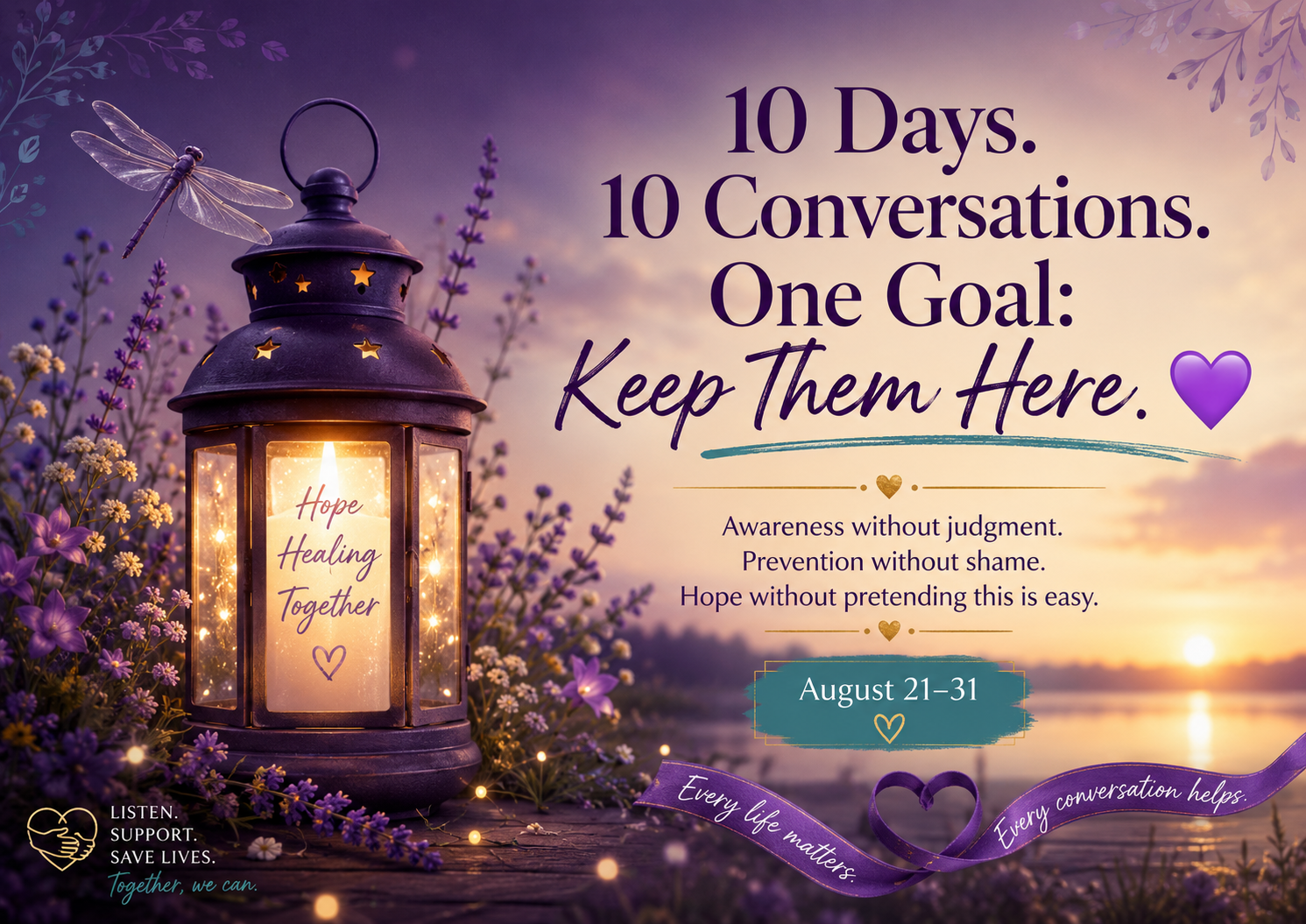
10 Days. 10 Conversations. One Goal: Keep Them Here.
Awareness without judgment.
Prevention without shame.
Hope without pretending this is easy.
Today’s Conversation 💬
Ask yourself:
If someone overdosed in front of me tonight, would I know where to find naloxone?
If the answer is no, change that.
Get some.
Learn how to use it.
Tell the people around you where it is.
And then hopefully?
Never need it.
But if that day ever comes, you will not be standing there wishing you had prepared.
For My Newark/Licking County Friends
Licking County Health Department’s Project DAWN provides naloxone and overdose education locally, including free kits available for pickup or by mail.
Tomorrow — Day 4
Would You Recognize an Overdose?
Tomorrow gets very practical.
What does an opioid overdose actually look like?
What sounds should concern you?
What happens to someone’s breathing?
What should you do first?
What should you not do?
And how do you respond when panic is screaming at you to freeze?
Because having Narcan only helps if someone recognizes that it is time to use it. 💜
Sources & Further Reading
Centers for Disease Control and Prevention (CDC) — Naloxone safety, overdose reversal, community access, and guidance for responding to suspected opioid overdose.
U.S. Food and Drug Administration (FDA) — Current information on over-the-counter naloxone, repeat dosing, emergency response, and expanded access to naloxone nasal sprays.
National Institute on Drug Abuse (NIDA) — How naloxone works and its role in reversing opioid overdose.
Substance Abuse and Mental Health Services Administration (SAMHSA) — Opioid overdose reversal medications and overdose prevention resources.
Licking County Health Department — Project DAWN — Local naloxone distribution and overdose education for Newark and Licking County residents.
Leave a Reply