
Knowing What You’re Seeing Could Save Someone’s Life
Yesterday we talked about Narcan.
We talked about why I think more ordinary people should carry naloxone—not because we expect an overdose to happen in front of us, but because sometimes terrible things happen without giving us time to prepare first.
But carrying Narcan only helps if somebody recognizes:
This is the moment I need to use it.
And I think that part deserves an entire conversation.
Because if I asked you right now:
“What does an opioid overdose look like?”
What would you picture?
Someone collapsing dramatically?
Someone obviously using drugs?
Needles nearby?
Foaming at the mouth?
Chaos?
Sometimes an overdose may look frighteningly obvious.
But sometimes?
It can look like somebody who fell asleep.
And that is exactly why we need to know the difference.
“They’re Just Sleeping.”
This is probably one of the most important things I want people to remember from today’s post:
If someone cannot be awakened, do not simply assume they are sleeping.
CDC lists unconsciousness or the inability to wake someone as one of the major warning signs of opioid overdose. I wish I knew that before, but I did not. Other signs can include very slow or shallow breathing, difficulty breathing, choking or gurgling sounds, a snoring-like noise from someone who cannot be awakened, discoloration around the lips or nails, and very small “pinpoint” pupils.
Read one of those again:
Snoring.
That one bothers me because snoring sounds so ordinary.
We hear someone snoring on the couch and think:
Well, apparently Bob is having himself a lovely nap.
But if Bob will not wake up and that “snoring” is actually abnormal, struggling, gurgling breathing?
That is not something to laugh off.
The difference is responsiveness and normal breathing.
If someone is making unusual snoring, choking, or gurgling noises and you cannot wake them, treat that as an emergency.
What Does “Not Breathing Normally” Mean?
During an opioid overdose, opioids can suppress the brain’s drive to breathe. Breathing can become very slow, shallow, irregular, or stop altogether. Without enough oxygen, brain injury and death can occur. Naloxone can reverse the opioid effect and help restore breathing, which is why acting quickly matters.
You do not need to stand over someone with a stopwatch trying to diagnose them.
You are looking for the bigger picture:
They will not wake up.
Their breathing seems extremely slow.
Their breaths are shallow.
There are long pauses.
They are gasping.
They are making choking, gurgling, or strange snoring sounds.
Their lips, gums, fingertips, or skin may look blue, gray, pale, or otherwise discolored.
Their body may be limp.
Their pupils may be extremely small.
Not every person will show every sign.
That matters too.
You do not have to complete an overdose bingo card before you are allowed to help.
If something looks terribly wrong?
Act.
Please Don’t Wait Until You Are “Sure”
I think this is where fear can make people freeze.
What if I’m wrong?
What if they are just asleep?
What if they didn’t take opioids?
What if I embarrass myself?
I would rather be embarrassed.
Every single time.
FDA and CDC guidance says naloxone can be given when an opioid overdose is suspected even if you are uncertain. If opioids are not involved, naloxone generally will not harm the person.
So you do not need toxicology results.
You do not need to know exactly what they took.
You do not need somebody standing beside you saying:
“Yes, definitely fentanyl.”
Remember what we talked about on Day 2.
Sometimes the person themselves did not know fentanyl was involved.
If they cannot wake up and are not breathing normally, waiting for certainty can cost time we do not have.
What Do You Actually Do?
This is the part I would love for people to screenshot.
This is not meant to replace CPR or naloxone training, and during an actual emergency you should follow the directions of the 911 dispatcher and the instructions for the naloxone product you have. But the basic response is something ordinary people can learn. Current CDC, FDA, SAMHSA, and American Heart Association guidance all emphasize rapid emergency response, naloxone when opioid overdose is suspected, and support for breathing while help is coming.
- Try to wake them. Call their name and check whether they respond. Look for normal breathing. If they cannot be awakened or are not breathing normally, treat it as an emergency.
- Call 911 immediately. If someone else is with you, have one person call while the other gets naloxone. Put the phone on speaker if you are alone so the dispatcher can guide you.
- Give naloxone if you have it and opioid overdose is possible. Do not wait until you know exactly what substance was taken.
- Support their breathing. The American Heart Association’s 2025 guidance says that when a person with suspected opioid overdose is unresponsive and not breathing normally, lay rescuers should provide CPR with breaths. A 911 dispatcher can coach you through CPR if you are unsure what to do.
- If they do not respond adequately, another naloxone dose may be needed. CDC advises waiting about 2–3 minutes after the first dose to see whether normal breathing returns before giving another dose; follow the instructions on the product you have.
- Stay with them. If they are unconscious but breathing, lay them on their side to reduce the risk of choking. Do not assume everything is okay simply because they wake up after naloxone. Its effect is temporary, and the person can become unconscious again. Stay until emergency help arrives.
That is a lot of words.
So if panic wipes everything else out of your brain, remember this:
Wake. Breathe. 911. Naloxone. Stay.
You do not have to perform the situation perfectly.
You just have to do something.
The Breathing Is the Emergency
This deserves its own section because I think we naturally focus on whether the person “wakes up.”
But the real emergency in an opioid overdose is the effect opioids can have on breathing.
Naloxone is important because it can reverse opioid effects and restore breathing. CDC says it can restore normal breathing within roughly two to three minutes when breathing has slowed or stopped because of an opioid overdose.
So after giving Narcan, do not simply stare at the person waiting for them to sit up dramatically like they do on television.
Look at the breathing.
Are they breathing normally?
Are they responding?
Is their condition improving?
And keep listening to the 911 dispatcher.
What If They Wake Up?
Wonderful.
Seriously.
That is exactly what we wanted.
But the emergency is not automatically over.
FDA warns that naloxone is temporary. Someone can respond initially and later become unconscious again because the opioid may remain active longer than the naloxone. Additional naloxone and emergency medical treatment may be necessary.
So if somebody wakes up and says:
“I’m fine.”
“I don’t need an ambulance.”
“Leave me alone.”
“I just want to go to bed.”
Please remember:
A person feeling better for the moment does not mean the danger has passed.
This is not the time to start arguing about:
Why they used.
Where they got it.
How angry you are.
Whether they promised last time.
Whose fault it is.
There will be plenty of time for hard conversations if we keep them alive long enough to have them.
Right now:
Medical emergency first.
Everything else later.
Please Don’t Leave Them Alone
This one feels so simple, but fear can make people do strange things.
Especially young people.
Imagine teenagers at a party.
Something goes wrong.
One of their friends will not wake up.
Everybody panics.
Somebody says:
“We’re going to get in trouble.”
And suddenly the instinct is:
Get out of here.
That is exactly the moment I want our kids to hear our voices in their heads.
Do not leave your friend.
Call 911.
Give naloxone if it is available.
Help them breathe.
Stay.
CDC specifically advises staying with the person until emergency assistance arrives.
Whatever trouble you think you might be in?
We will figure that out.
But you cannot undo leaving someone without oxygen because everyone was scared of being caught.
This Is Why Our Kids Need to Know Too
Yesterday we talked about carrying Narcan.
But if we put naloxone in our homes and never explain to our teenagers what an overdose looks like, we have only done half the job.
I want my kids to know what that little box is.
I want them to know where it is.
I want them to know:
If someone will not wake up, you are allowed to use it.
I want them to know that if they are wrong and opioids are not involved, naloxone is not going to punish the person for their mistake. FDA specifically says naloxone generally will not harm someone who does not have opioids in their system.
Most importantly?
I want them to understand that calling for help is never something they should be ashamed of.
“But I Would Panic.”
Oh, absolutely.
So would I.
I wish I could tell you that knowing what to do means you will suddenly become calm, cool, and collected while everyone around you is screaming.
Probably not.
You may shake.
You may cry.
You may forget everything you have ever learned.
You may be screaming at the 911 operator while searching a kitchen drawer for Narcan you swear was right there yesterday.
You are human.
Courage during an emergency does not mean you are not scared.
It means you act while scared.
Call.
Listen.
Give the medication.
Follow directions.
Stay.
You don’t have to become the paramedic.
You just have to help keep that person alive until the paramedics arrive.
Learn This Before Someone You Love Needs You
There are certain things in life I think everybody should learn even though we desperately hope we never use them.
CPR.
How to use a fire extinguisher.
What choking looks like.
How to use an AED.
And now?
I would add:
How to recognize an opioid overdose and administer naloxone.
The American Heart Association’s current CPR guidance specifically incorporates naloxone into response for suspected opioid-related respiratory and cardiac emergencies, and federal health agencies encourage community members—not only medical professionals—to learn how to use it.
This knowledge belongs in ordinary homes.
Because overdoses happen in ordinary families.
I Keep Coming Back to the Same Thought
There are moments after a loss when your brain becomes almost cruel with questions.
What if?
What if somebody had known?
What if someone had been there?
What if someone had recognized it sooner?
What if Narcan had been nearby?
What if somebody had called?
There are families carrying those questions forever.
We cannot rewrite those stories.
But we can learn something from them.
Maybe today somebody reads this who will someday hear strange snoring from the next room.
Maybe they will remember:
Try to wake them.
Maybe a college kid finds a friend unconscious.
Maybe instead of leaving because everyone is scared, somebody says:
Call 911. Get the Narcan.
Maybe somebody recognizes that blue or gray lips are not “sleeping it off.”
Maybe somebody responds two minutes sooner.
Maybe tomorrow morning one mother receives a very different phone call than the one she could have received.
That matters.
Today’s Conversation 💬
Ask the people in your house:
“Would you know what an opioid overdose looks like?”
Let them answer before you teach them.
Then tell them the warning signs:
Someone cannot be awakened.
Their breathing is very slow, shallow, irregular, or stopped.
They may make choking, gurgling, or unusual snoring sounds.
Their lips, nails, or skin may become discolored.
Their body may be limp.
Their pupils may become extremely small.
Then show them where the naloxone is kept.
Not someday.
Today.
And make sure everybody knows the most important part:
If you’re unsure, call for help anyway.
Nobody needs you to diagnose an overdose.
They need you to recognize an emergency.
Love,
~Mandy💜
Day 4 — Would You Recognize an Overdose?
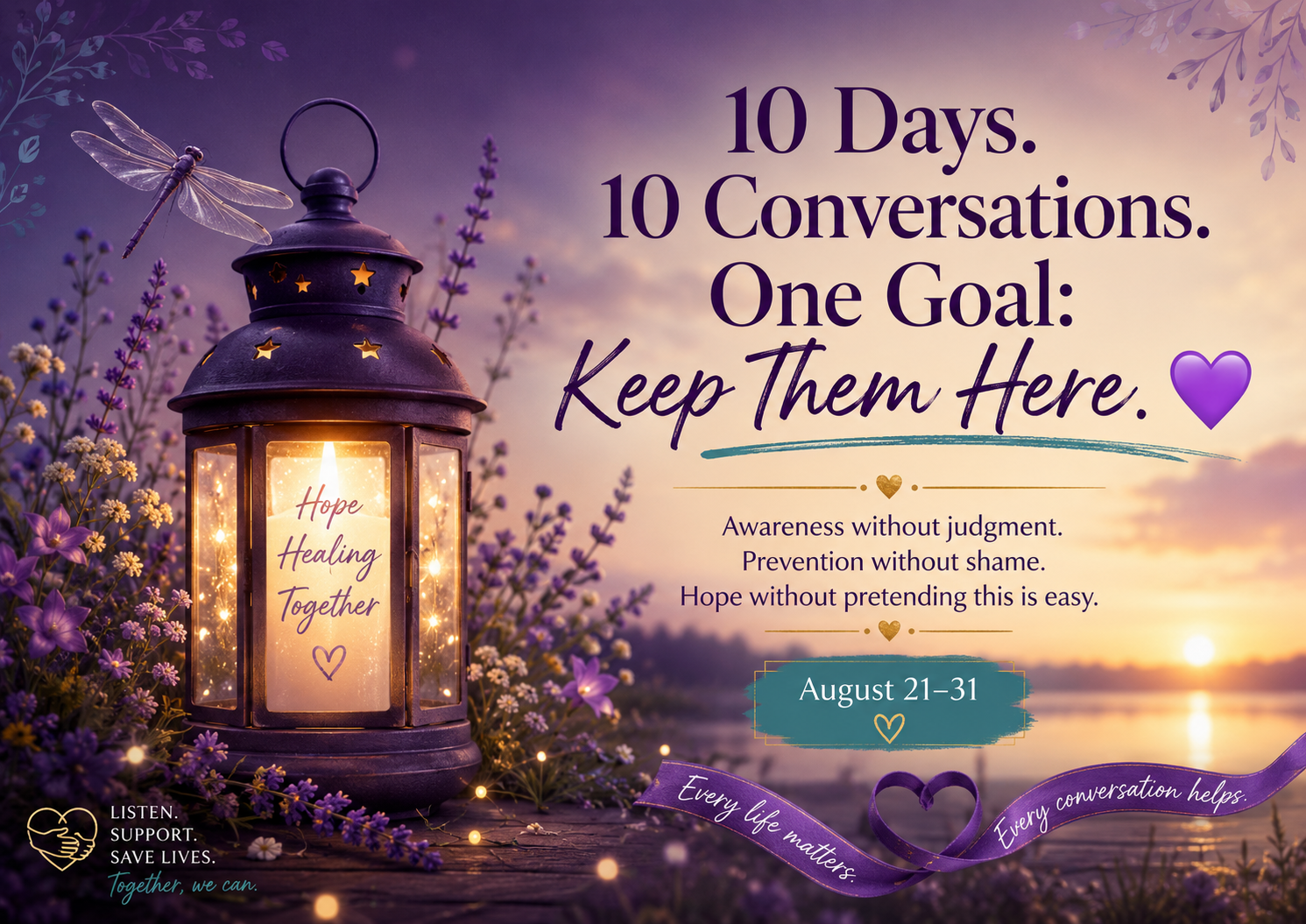
10 Days. 10 Conversations. One Goal: Keep Them Here. 💜
Awareness without judgment.
Prevention without shame.
Hope without pretending this is easy.
And today, maybe we add one more:
Recognition without hesitation.
Because in an overdose, minutes matter.
And sometimes knowing what you are looking at is the very first thing that keeps someone here.
Tomorrow — Day 5 💜
Please Talk to Your Kids—Even the “Good Kids”
Tomorrow we’re talking to parents.
Not because every teenager is using drugs.
Not because every teenager is secretly hiding something.
And definitely not because I think we should terrify our children.
We’re talking because good kids are still human kids.
They have friends.
They go to parties.
They experience pressure.
They get curious.
They hurt.
They make mistakes.
And sometimes they are simply standing beside somebody else when that person makes one.
Tomorrow we are going to talk about what our kids actually need to hear from us—and why one of the most important sentences may be:
“If you ever get into trouble, call me. I want you alive more than I want you afraid of me.” 💜
Sources & Further Reading
The medical guidance in this post was checked against current information from the Centers for Disease Control and Prevention, U.S. Food and Drug Administration, Substance Abuse and Mental Health Services Administration, and the 2025 American Heart Association CPR and Emergency Cardiovascular Care Guidelines.
Leave a Reply