
Because Good Kids Are Still Human Kids
There is a sentence parents say all the time:
“My kid would never do that.”
I understand it.
I have probably said some version of it myself about one thing or another.
We know our children.
We know their personalities.
We know how we raised them.
We know which child tests every boundary we create and which one apologizes for something they did not even do. 😂
We know the rule followers.
The risk takers.
The homebodies.
The social butterflies.
The athletes.
The honor-roll kids.
The gamers who would happily survive for three days on chips and whatever beverage happens to be within arm’s reach.
We know our kids.
But knowing our children does not mean knowing every situation they will ever find themselves in.
And that is why I think one of the most dangerous assumptions we can make is:
“I don’t need to talk to my child about fentanyl because my child doesn’t do drugs.”
I hope they don’t.
I hope they never do.
But please talk to them anyway.
I Put “Good Kids” in Quotation Marks for a Reason
Because I don’t actually believe there are “good kids” who need drug education and “bad kids” who use drugs.
Life is much more complicated than that.
A teenager can be responsible and still make an impulsive decision.
A college student can be brilliant and still experiment with something.
A kid can love their family deeply and still hide something because they are terrified of disappointing them.
Someone can struggle with anxiety.
Depression.
Trauma.
Loneliness.
Pain.
Curiosity.
Pressure.
Wanting to fit in.
Wanting to feel different for a few hours.
Wanting to stay awake.
Wanting to sleep.
Wanting their brain to simply stop for a little while.
None of those things tell us whether someone is a good person.
They tell us they are human.
And human beings sometimes make decisions we desperately wish they had not made.
First, We Need to Stop Talking About Fentanyl Like It Is Only a Pill
This is something I want to correct as we move through this series.
We spent an entire day talking about counterfeit pills because they are a very real danger—especially for teenagers and young adults.
But fentanyl does not only come disguised as a pill.
Illegally manufactured fentanyl is commonly found as a powder or pressed into counterfeit pills. It can also be mixed with drugs such as heroin, cocaine, and methamphetamine. People may smoke it, snort it, inject it, or ingest it. Some people encounter fentanyl without knowing it is present. Others knowingly use fentanyl.
All of those realities belong in this conversation.
Because if all we ever tell our kids is:
“Watch out for fake pills,”
they may walk away thinking everything else is somehow outside the fentanyl problem.
It isn’t.
Someone may use powder.
Someone may snort a drug.
Someone may smoke fentanyl—sometimes with aluminum foil or other smoking paraphernalia present.
Someone may inject it.
Someone may believe they are using cocaine, methamphetamine, heroin, or another substance that also contains fentanyl.
Someone may knowingly buy fentanyl because they have become dependent on it.
The paths are different.
The overdose risk is still real.
CDC overdose surveillance has actually documented a substantial shift toward smoking and other non-injection routes. From early 2020 through late 2022, the percentage of overdose deaths with evidence of smoking increased sharply, while evidence of injection decreased. Among deaths in which only illegally manufactured fentanyl was detected, evidence of smoking increased nearly 79%. CDC’s surveillance definition of smoking evidence includes items such as pipes, stems and aluminum foil found at overdose scenes.
That is important information.
Because the image many adults still carry of opioid addiction is:
Needle = serious drug problem.
That picture is outdated.
Someone does not have to inject fentanyl to overdose from it.
The Conversation Has Changed
Parents have always needed to talk to kids about drugs.
But fentanyl has changed what that conversation needs to include.
We still absolutely need to talk about counterfeit pills.
CDC’s current youth-awareness materials report that from 2020 through 2024, 75% of overdose deaths among young people ages 10–19 involved fentanyl, and nearly half of teens were unaware that counterfeit prescription pills may contain lethal amounts of illegally manufactured fentanyl.
That tells me we cannot simply assume:
They already know.
But knowing about counterfeit pills is only one piece.
I want our kids to understand:
Fentanyl can be powder.
It can be smoked.
It can be snorted.
It can be injected.
It can be swallowed.
It can be mixed into other drugs.
Someone may know they are using fentanyl.
Someone else may have absolutely no idea it is there.
That is a much more accurate picture of the world they are living in.
“But My Child Would Never Smoke Fentanyl.”
Maybe not.
Hopefully not.
But your child could know someone who does.
That’s the part I think we miss.
Drug education is not only about preventing your child from using drugs.
It is also about preparing your child to live in a world where other people do.
Maybe their friend starts using.
Maybe their roommate does.
Maybe somebody at a party does.
Maybe they notice foil repeatedly showing up somewhere and have no idea why.
Maybe they see powder and assume:
Well, fentanyl is pills, so that can’t be fentanyl.
Maybe somebody snorts something and then becomes unresponsive.
Maybe a friend who normally uses cocaine unexpectedly shows signs of an opioid overdose because fentanyl was present too.
That is why accurate information matters.
I would much rather my child recognize:
Something about this is not right.
than stand beside someone who is dying and have absolutely no idea what they are looking at.
Please Don’t Make This a Scared-Straight Speech
I know the temptation.
We discover something terrifying and immediately want to sit everybody down at the kitchen table.
Phones away.
Television off.
Nobody leaves until Mom has completed her 47-slide presentation. (please tell me I am not the only one who does this….)😂
I understand.
But the goal is not simply for our children to hear us talking.
The goal is for them to talk back.
SAMHSA’s Talk. They Hear You. campaign encourages parents and caregivers to begin conversations about alcohol and other drugs early and continue them over time rather than treating prevention as one enormous lecture.
That makes so much sense to me.
Drug education should not be:
The Talk.
It should be:
The talks.
Five minutes in the car.
Something that came up on television.
A news story.
A question about something happening at school.
Something you saw online.
“Hey, have you heard about this?”
“What are kids saying about that?”
“What would you do if…?”
Those conversations feel very different from:
“Sit down. We need to talk.”
Nothing has ever made a teenager suddenly remember an urgent homework assignment faster than those six words. 😂
Start By Finding Out What They Actually Know
Before telling them everything you know, ask them.
Try:
“What have you heard about fentanyl?”
Then stop talking.
Seriously.
This may be the hardest step for parents. 😂
Listen.
Maybe they know a lot.
Maybe they know very little.
Maybe some of what they believe is completely wrong.
Maybe they know things you didn’t.
Then go a little deeper:
“What does fentanyl look like?”
“How do people use it?”
“Have you heard about counterfeit pills?”
“Did you know fentanyl can also be powder?”
“Have you heard about people smoking fentanyl?”
“Would you know what Narcan is?”
“Would you know what an overdose looks like?”
“What would you do if one of your friends took something and couldn’t wake up?”
Now you have a conversation.
And perhaps more importantly?
You know what your child actually understands.
Yes, Tell Them About the Pills
We should absolutely keep this part.
If someone is considering taking what they believe is prescription medication, I want this sentence burned into their memory:
If it wasn’t prescribed to you and dispensed to you by a licensed pharmacy, you cannot know for certain what is in it.
Counterfeit pills can closely resemble legitimate medications while containing illegally manufactured fentanyl or other substances. DEA continues to warn that appearance cannot establish whether a pill is legitimate.
Not:
“My friend has taken these before.”
Not:
“It came in a bottle.”
Not:
“It has the right numbers stamped on it.”
Not:
“The guy swears it’s real.”
Not:
“My friend knows him.”
Not:
“It looks exactly like mine.”
Those things do not verify what is inside it.
And sometimes the friend handing over the pill isn’t deliberately lying.
They may not know either.
Trusting the person is not the same thing as knowing what is in the drug.
That is still an incredibly important conversation.
But it isn’t our only conversation.
Talk About Powder, Foil and Other Drug Use Too
I think parents need to be willing to use the actual words.
Not because we want to teach children how to use drugs.
Because if they encounter something, recognizing it matters.
If you see aluminum foil associated with drug use, don’t automatically assume:
Well, at least they’re not injecting.
Smoking fentanyl can still result in fatal overdose. CDC specifically says overdose-prevention messaging needs to address smoking and other non-injection routes because overdose risk remains substantial.
The same is true for snorting.
No needle does not mean no opioid risk.
That myth can be dangerous.
I want kids to understand:
The method of using a drug does not make fentanyl harmless.
And if somebody becomes unresponsive after smoking, snorting, swallowing, or injecting something?
The response we discussed yesterday does not change.
Try to wake them.
Check their breathing.
Call 911.
Give naloxone if an opioid overdose might be happening.
Stay with them.
Some People Know They Are Using Fentanyl
I also think this matters because compassion requires honesty.
Not every fentanyl death involves someone who was tricked.
Not every person believed they were taking Xanax.
Not every exposure is accidental contamination.
There are people who knowingly use fentanyl.
There are people whose bodies have become dependent on it.
There are people living with opioid-use disorder who continue using despite desperately wanting their lives to be different.
If our entire prevention message becomes:
“People don’t know fentanyl is in their drugs,”
we accidentally erase them.
And they matter too.
This campaign is called Keep Them Here.
Not:
Keep only the people here who didn’t know what they took.
Someone who knowingly used fentanyl still deserves emergency care.
Someone who has overdosed before still deserves Narcan.
Someone who relapsed still deserves another chance at treatment.
Someone who smoked it knowing exactly what it was is still somebody’s child.
Their life does not become less valuable because their circumstances are harder for us to understand.
Then We Need to Say Something Hard as Parents
After telling our children:
Do not take it.
I also want them to know what happens if they do.
And some parents worry that saying this somehow gives permission.
I don’t believe it does.
I can tell my child:
“I do not want you using drugs.”
And then immediately say:
“But if you ever do, and you become scared, call me.”
Both things can be true.
I can have a boundary.
And an emergency plan.
I can disapprove of the decision.
And still want my child alive.
Those are not contradictions.
“Call Me. Even If You Screwed Up.”
I would love for every kid to hear some version of this from somebody they trust:
If you ever get yourself into something you should not have gotten into, call me.
If you drank when you weren’t supposed to…
Call me.
If you went somewhere you lied about going…
Call me.
If you swallowed something and now you’re scared…
Call me.
If you smoked or snorted something and something feels wrong…
Call me.
If your friend used something and now you cannot wake them…
Call 911 first.
Then call me.
If you think you are going to be in trouble?
You might be. 😂
But we will deal with that when everybody is safe.
I want you alive more than I want you afraid of me.
That sentence matters to me.
Because fear of consequences should never become the reason somebody waits during a medical emergency.
And Please Tell Them About Their Friends
Your child may genuinely never use an illicit drug. Not ever.
They still need this information.
Because someday they might be standing beside somebody who does.
Imagine how valuable it would be if teenagers knew:
If your friend will not wake up…
If their breathing is strange, slow, or stopped…
If they are making choking, gurgling, or unusual snoring sounds…
If their color looks wrong…
Do not leave them to “sleep it off.”
Call 911.
Give naloxone if it is available.
Stay with them!!!
And do not waste precious minutes trying to determine:
Was it a pill?
Powder?
Fentanyl?
Cocaine?
Heroin?
Something smoked?
Something snorted?
Something mixed together?
During an emergency, you are not the toxicology lab.
You are the person standing beside someone who needs help.
Help them.
Teach Them Where the Narcan Is
If you have naloxone in your home, there is another step.
Tell your children where it is.
Show them the box.
Show them what the device looks like.
Explain what it does.
Explain that naloxone can reverse an opioid overdose.
Explain that they should call 911.
Explain that fentanyl may have been swallowed, smoked, snorted, injected, or unknowingly mixed with another substance—and none of that changes the fact that suspected opioid overdose requires an emergency response.
And perhaps most importantly:
Make sure they know they are allowed to use it to save a life!!!
A lifesaving medication hidden somewhere nobody is supposed to touch isn’t particularly useful during an emergency.
Don’t Assume College Means the Conversation Is Over
This is another place where I think parents sometimes stop too soon.
We educate them until high-school graduation.
Then suddenly:
Well, off you go! You’re 18 now. Godspeed.
Young adulthood actually brings entirely new situations.
Dorms.
Parties.
New friend groups.
More independence.
Less supervision.
Stress.
Pressure to perform academically.
Mental-health struggles.
Alcohol.
Experimentation.
Substance use within their friend group.
So yes.
Talk to your 13-year-old.
Talk to your 16-year-old.
Talk to your 18-year-old.
Talk to your 22-year-old.
Frankly, if my child is 35 and I learn something that might keep them alive, I am probably still sending the text.
At some point parenting becomes:
“I know you’re grown, but I read a thing.” 😂
They can roll their eyes.
I can live with that.
Don’t Let “Not My Child” Become “I Never Told Them”
There is something incredibly difficult about writing about prevention after experiencing loss.
Because hindsight is merciless.
Once something terrible happens, your brain loves to return to all the places where you imagine you might somehow have changed it.
What if I had known this?
What if we had talked about that?
What if I had recognized something?
What if I had asked another question?
Those questions can consume a person.
And there are no perfect parents.
There never were.
There is no conversation that guarantees a child will never use drugs.
There is no parenting strategy that gives us complete control over another human being’s choices.
There is no magical sentence that eliminates addiction.
If there were?
Every parent on earth would memorize it before leaving the hospital with their baby.
Prevention is not about creating perfect parents or perfect children.
It is about increasing the chance that somebody has information before they need it.
Learn.
Teach.
Listen.
Prepare.
Love.
And keep talking.
Shame Is Not a Safety Plan
I keep coming back to shame during this series because I think it matters.
If our children believe:
“If Mom ever knew, she would never look at me the same way again,”
they may hide.
If they believe:
“Dad would absolutely lose it,”
they may hide.
If admitting experimentation means becoming the bad kid…
they may hide.
If someone has already become dependent on fentanyl and believes telling their family will only bring disgust?
They may hide even more.
That doesn’t mean we have to approve of what’s happening.
It means I want the relationship strong enough that truth has somewhere to land.
SAMHSA’s prevention guidance encourages parents to clearly communicate disapproval of underage substance use while also staying involved and continuing the conversation.
That balance matters.
I don’t approve of this.
and
You can still tell me.
Both.
Maybe the First Conversation Is With Ourselves
Parents have baggage too.
We grew up with certain pictures of drug use.
Drug users look like…
“Addicts” do this…
Heroin users use needles…
Fentanyl means fake pills…
Good families don’t…
Good kids don’t…
But today’s drug supply doesn’t care about our stereotypes.
And our stereotypes can leave enormous blind spots.
Maybe the kid is not injecting.
Maybe there are no needles.
Maybe what we notice is foil.
Maybe it’s powder.
Maybe there is a straw.
Maybe it’s a counterfeit pill.
Maybe we notice absolutely nothing.
The point isn’t to turn parents into detectives.
It is to stop allowing one outdated image of addiction to convince us that everything must be fine if our family doesn’t look like that image.
And perhaps we should ask ourselves:
If my child told me something frightening tonight, could I listen long enough for them to finish?
Not approve.
Not ignore.
Not pretend everything is okay.
Just listen.
There will be time to decide what comes next.
Sometimes the first job is making sure our child keeps talking.
What I Want Our Kids to Know
I want them to know fentanyl is dangerous.
I want them to understand counterfeit pills.
I want them to know fentanyl can also be powder.
I want them to know it can be mixed into other drugs.
I want them to understand people may smoke it, snort it, inject it, or ingest it.
I want them to know that some people encounter fentanyl unknowingly and some knowingly use it.
I want them to understand addiction is real.
I want them to recognize an overdose.
I want them to know how to use naloxone.
I want them to call 911.
But underneath every one of those lessons, I want another message running quietly:
Your life is worth saving.
Even if you made a mistake.
Even if you broke a rule.
Even if you lied.
Even if you used.
Even if you knew exactly what you were using.
Even if you relapsed.
Even if I am furious.
Even if there are consequences tomorrow.
Tonight, come home alive.
We will figure out the rest from there.
Because “Good Kids” Make Mistakes Too 💜
Maybe your kid genuinely is the least likely teenager on earth to ever experiment with drugs.
Wonderful.
I hope you’re right.
Tell them anyway.
Because information doesn’t corrupt good kids.
Information equips them.
Maybe they never need it for themselves.
Maybe someday they use it for a friend.
Maybe years from now they teach it to their own children.
We cannot guarantee what situations our children will encounter.
But we can make sure our voices are already somewhere inside their heads when they do.
And if there is one sentence I want mine to hear when everything goes terribly wrong, it is this:
Call me.
You might have screwed up.
We might have a very long conversation tomorrow.
There might be consequences.
I might cry.
You might cry.
I may need approximately three business days before I can speak without using your entire legal name. 😂
But call me.
Because none of that matters more than this:
I want you here tomorrow.
Love,
~Mandy 💜
Day 5 — Please Talk to Your Kids—Even the “Good Kids”
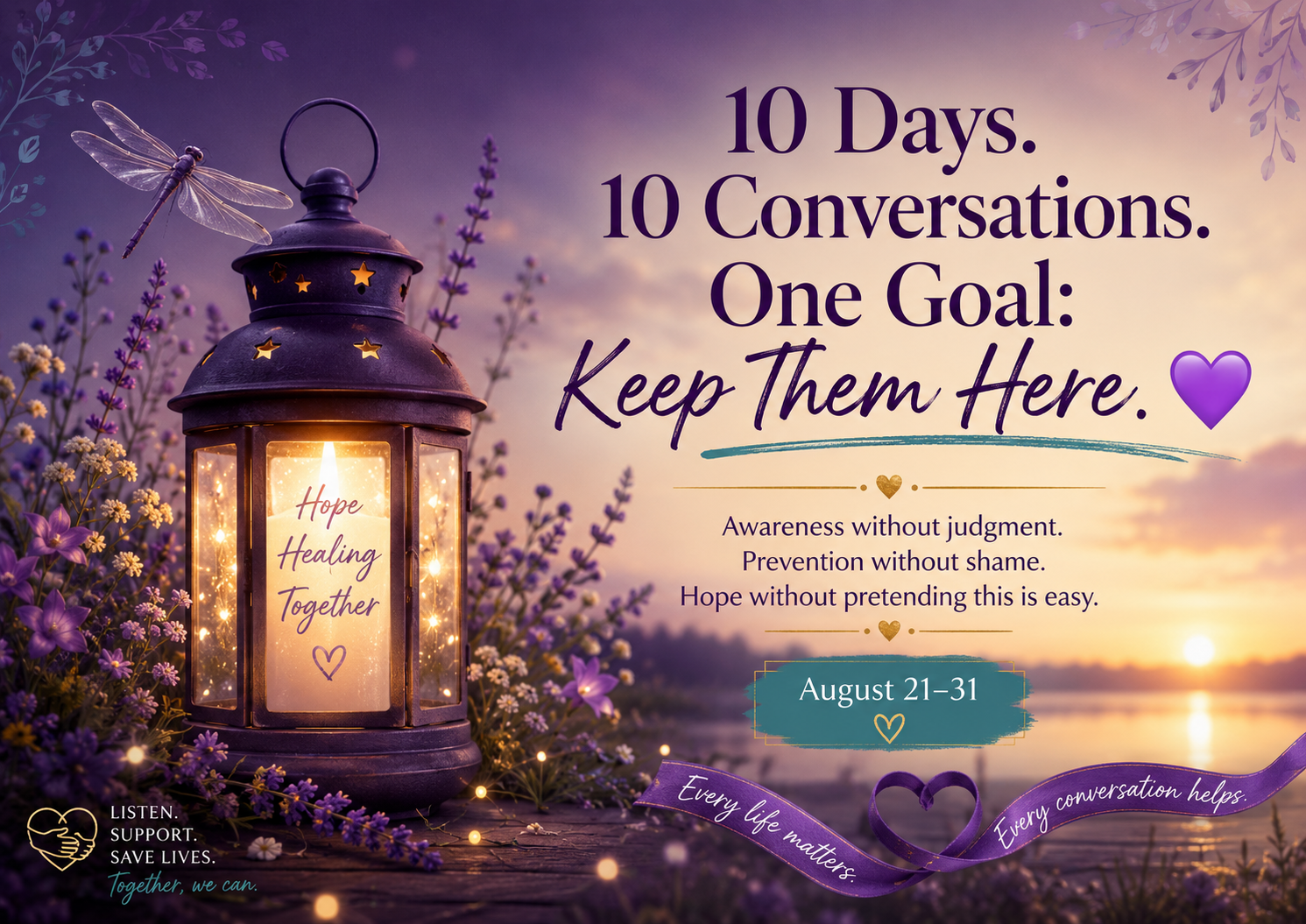
10 Days. 10 Conversations. One Goal: Keep Them Here. 💜
Awareness without judgment.
Prevention without shame.
Hope without pretending this is easy.
Today’s Conversation 💬
Tonight, ask your child:
“What do you know about fentanyl?”
Then let them answer.
You might follow with:
“What do you think it looks like?”
“Did you know it can be powder as well as counterfeit pills?”
“Did you know people may smoke it or snort it, not only inject it?”
“Did you know fentanyl can be mixed into other drugs?”
“Would you recognize an opioid overdose?”
“Do you know where our Narcan is?”
And before the conversation ends, make sure they know:
Fentanyl isn’t only pills.
No needle does not mean no overdose risk.
They should never leave an unconscious friend to sleep it off.
If an opioid overdose is possible, call 911 and use naloxone if available.
And:
“If you ever get yourself into trouble, call me. I want you alive more than I want you afraid of me.”
They may roll their eyes.
They may say:
“I KNOW, Mom.”
Good.
Let them know anyway.
Sometimes I know, Mom means:
I heard you. 💜
Tomorrow — Day 6 🌱
Addiction Rarely Begins With Someone Wanting Addiction
Tomorrow we’re going deeper.
And this correction actually makes that conversation even more important.
Because some people unknowingly encounter fentanyl.
Others eventually knowingly seek it.
Some smoke.
Some snort.
Some inject.
Some swallow pills.
Some use multiple substances.
And somewhere between the beginning of a person’s story and the place where their life becomes consumed by a substance…
something happened.
Tomorrow we’re going to ask why.
Biology.
Genetics.
Trauma.
Mental health.
Pain.
Environment.
Coping.
Access.
Dependence.
And how drug use can change over time.
Understanding addiction doesn’t mean excusing everything addiction causes.
But if we want to prevent it, treat it, and help people survive it?
We need to understand what we’re actually fighting. 💜
Sources & Further Reading
Centers for Disease Control and Prevention (CDC) — Illegally manufactured fentanyl may occur as powder or counterfeit pills and may be smoked, snorted, injected, or ingested; it may also be mixed with other illicit drugs.
CDC — Routes of Drug Use Among Drug Overdose Deaths — National surveillance showing increased evidence of smoking and other non-injection routes in overdose deaths, including fentanyl-involved deaths; surveillance evidence for smoking includes aluminum foil and other smoking paraphernalia.
CDC — Youth Fentanyl Awareness — Current information on fentanyl involvement in youth overdose deaths and youth awareness of counterfeit-pill risks.
SAMHSA — Talk. They Hear You. — Resources encouraging ongoing conversations between parents, caregivers, and young people about alcohol and other substance use.
Drug Enforcement Administration (DEA) — Information about counterfeit prescription pills and illegally manufactured fentanyl.
Leave a Reply