
Somewhere Between the First Use and “Why Can’t You Just Stop?”—Something Changed
I don’t think many people begin using a substance with a life plan that sounds like this:
I would really like to become dependent on this.
I hope this destroys some of my relationships.
Maybe someday my family will be terrified every time my phone goes unanswered.
I’d love to spend my life planning around whether I can get enough of a substance to keep from becoming sick.
Nobody puts “develop opioid use disorder” on their vision board.
And yet families all over this country eventually find themselves asking:
How did we get here?
That question is much harder to answer than:
“They made a bad choice.”
Because sometimes there was a choice at the beginning.
Sometimes there were many choices.
But addiction is not simply one bad decision repeated over and over again.
The person standing in front of you years later may be dealing with something very different from the person who took that first drug.
There Is No Single Road Into Addiction
This is probably the most important thing to understand today.
There isn’t one addiction story.
Somebody experiments because they are curious.
Someone wants to have fun at a party.
Someone wants to fit in.
Someone is prescribed medication for legitimate pain.
Someone is trying to sleep.
Someone wants to stay awake.
Someone is grieving.
Someone has anxiety and discovers that, for a little while, a substance quiets their brain.
Someone has experienced trauma.
Someone grows up around substance use and it feels normal.
Someone is young and impulsive.
Someone simply likes how a drug makes them feel.
And sometimes?
There isn’t a dramatic explanation at all.
NIDA says no single factor determines whether someone will develop a substance use disorder. Risk can involve genetics, age, mental health, family and peer environments, trauma, chronic stress, drug availability, patterns of substance use, and other life circumstances. Many people use a substance and never develop a disorder; others are much more vulnerable.
That matters.
Because if we’re looking for the reason someone became addicted, we may spend years looking for an answer that doesn’t exist.
Usually, it is more complicated than one thing.
Risk Is Not Destiny
I want to make this especially clear when we talk about trauma.
Trauma matters.
Research consistently connects trauma and chronic stress with increased vulnerability to substance-use problems. But NIDA is also very clear that not everyone who experiences trauma develops a substance use disorder. Genetics, environment, family history, previous substance use, childhood adversity, and other factors interact with one another.
So I don’t want us turning this into another stereotype:
“People with addiction must have had terrible childhoods.”
No.
Some did.
Some didn’t.
Some have trauma nobody knows about.
Some grew up in loving, stable homes.
Some had every opportunity imaginable.
Some grew up surrounded by chaos.
Addiction does not require one particular childhood, income level, family structure, personality, or zip code.
That is part of what makes it so difficult to wrap our minds around.
We like explanations that fit nicely into boxes.
Human beings rarely do.
Genetics Matter Too
This is another part of addiction that can make people uncomfortable because it challenges the idea that everybody begins with exactly the same level of risk.
They don’t.
NIDA estimates that genetics—including the ways environment can affect gene expression—account for roughly 40% to 60% of a person’s vulnerability to addiction. Developmental stage and other biological factors matter as well.
That doesn’t mean someone with addiction in their family is doomed.
Far from it.
It means risk is different from person to person.
Two people can take the same substance.
One walks away from it.
The other keeps thinking about it.
Why?
The simple answer is: Human brains and human lives aren’t identical.
This is why I struggle with statements like:
“Well, I used drugs when I was young and I never became addicted.”
Okay.
I’m genuinely glad you didn’t.
But your experience does not prove somebody else should have had exactly the same response.
We wouldn’t say:
“I smoked for twenty years and never got lung cancer, so I don’t understand why she did.”
Risk doesn’t work like that.
Mental Health and Substance Use Often Meet Each Other
This is another place where the story can become tangled.
Mental-health disorders and substance-use disorders often occur together. NIDA identifies conditions including anxiety, depression, PTSD, and others among disorders that commonly co-occur with substance-use problems. The relationship can move in different directions: shared vulnerabilities can contribute to both conditions, some people use substances in an attempt to cope with psychological distress or pain, and substance use itself can worsen mental-health symptoms.
In other words:
Sometimes somebody is using because they are trying to feel something.
Sometimes they are trying desperately to stop feeling something.
Anxiety.
Panic.
Memories.
Physical pain.
Grief.
Loneliness.
Stress.
Depression.
Whatever it is.
The substance may initially seem to work.
For an hour, perhaps the brain gets quiet.
For the first time in weeks, someone sleeps.
For a little while, something doesn’t hurt.
And that matters when we’re trying to understand why someone would return to something dangerous.
Understanding the reason does not make the danger disappear.
It helps explain why saying: “Just don’t do it again.” may not be enough.
Sometimes the Beginning Wasn’t Pain at All
I also don’t want us romanticizing addiction into a story where every person was simply wounded and trying to survive.
Sometimes somebody tried a drug because:
It felt good.
That’s real too.
Drugs can activate reward systems in the brain and reinforce the behavior that produced the pleasurable effect, making someone more likely to repeat it. With repeated drug exposure, changes can occur in brain systems related to reward, stress, learning, judgment, and self-control.
Sometimes the first thought really was:
That was fun.
Then:
I’ll do it again.
Then:
I’ll just do it on weekends.
Then perhaps:
I need something to get through today.
Human behavior can change gradually enough that nobody notices exactly where the line was crossed.
Including the person using.
The First Use and the Hundredth Use Are Not the Same Decision
This is something I wish more people understood.
There can absolutely be choice involved in substance use.
Saying addiction is a health condition does not require pretending human choices disappear.
But choice becomes much more complicated as a substance-use disorder develops.
NIDA describes opioid use disorder as a chronic, treatable medical condition that can involve taking opioids in larger amounts or for longer than intended, powerful cravings, continuing to use despite harm, and withdrawal when opioid use stops.
Think about that.
For longer than intended.
That means the person themselves may have intended something different.
I’m stopping tomorrow.
This is the last time.
I’m done after this.
Families hear those sentences and eventually stop believing them.
I understand why.
When someone has promised something fifteen times, words start meaning very little.
But sometimes the person saying: “I don’t want to do this anymore,” actually means it.
And then they use again.
That’s one of the cruelest parts of addiction.
Dependence and Addiction Are Not Exactly the Same Thing
This distinction is important, especially with opioids.
Physical dependence means the body has adapted to a drug so that suddenly stopping it can cause withdrawal.
That can occur with repeated opioid exposure, including in people taking certain medications appropriately.
Opioid use disorder is broader. It involves a problematic pattern of opioid use that can include craving, loss of control, continued use despite consequences, and other symptoms.
Why does this matter?
Because when someone says: “Why don’t they just stop?” the answer can include something very physical.
Withdrawal.
Opioid withdrawal can involve intense sickness, pain, sleep problems, stomach symptoms, cravings, and other distressing symptoms. I watched my son withdraw. It was horrific. I cannot imagine being the one going through it. Treatments exist specifically to reduce withdrawal and cravings because those symptoms can be major barriers to stopping opioid use.
So imagine telling yourself:
I’m done.
And then your body starts screaming:
No, you’re not.
That does not mean recovery is impossible.
It means recovery may require much more than willpower.
This Helps Explain Something Else: Knowing It Is Fentanyl
Earlier in this series, we spent a lot of time talking about people who encounter fentanyl unknowingly.
That matters.
Counterfeit pills and drugs containing unexpected fentanyl kill people.
But we corrected something yesterday that I think is incredibly important:
Not everyone using fentanyl is being tricked.
Some people know they are using fentanyl.
Some smoke it.
Some snort it.
Some inject it.
Some use it alongside other substances.
And once someone has developed opioid use disorder, the question may no longer be:
“Why would anybody choose something this dangerous?”
A better question might be:
“What is happening inside this person’s life and body that makes continuing to use feel necessary despite knowing the danger?”
That doesn’t make using fentanyl safe.
It doesn’t excuse lying, stealing, manipulation, or harm done to a family.
It simply gets us closer to understanding what we are actually dealing with.
Because screaming:
“DON’T YOU KNOW THIS COULD KILL YOU?”
at somebody with opioid use disorder may accomplish less than we think.
They may know.
Very well.
And still use.
That’s the disorder.
“But They Keep Choosing It Over Their Family.”
This one hurts.
Especially for families.
A spouse thinks:
If you loved me, you would stop.
A child thinks:
Why wasn’t I enough?
A mother thinks:
How can you look at everything this is doing to us and still go back?
Those feelings are real.
Addiction can absolutely devastate families.
Trust gets destroyed.
Money disappears.
Promises get broken.
People become exhausted.
Children can be traumatized.
Partners can reach a point where they cannot continue living in the chaos.
Parents may need boundaries they never imagined having to create.
Understanding addiction should never become:
“Therefore everyone around the person must tolerate anything they do.”
No.
You are allowed to have boundaries.
You are allowed to say:
You cannot live here while this is happening.
I will not give you money.
I will not lie for you.
I will not allow this around the children.
I love you, and I cannot keep participating in this.
Compassion and boundaries are not opposites.
Sometimes boundaries are part of loving someone without allowing addiction to consume the entire family.
But there is one belief I desperately want families to question:
Their continued drug use does not automatically mean they love the drug more than they love you.
Addiction is more complicated than a contest between drugs and Mom.
If love alone cured opioid use disorder?
There would be an enormous number of families who could have loved their people sober years ago.
“What Happened to You?” Is Useful—but It Isn’t the Only Question
You have probably heard the shift from:
“What’s wrong with you?”
to:
“What happened to you?”
I understand why that language is powerful.
It moves us away from condemnation and toward curiosity.
But after digging deeper into this, I think we can go even further.
Maybe we ask:
What happened to you?
What is hurting?
What did this substance do for you when you first started using it?
What does it do for you now?
What makes stopping difficult?
What happens when you try?
What support have you actually been offered?
What barriers keep you from treatment?
Because there may not be one dramatic thing that happened.
There may be genetics.
Mental illness.
Pain.
Peer influence.
Trauma.
Availability.
Experimentation.
Dependence.
Stress.
Poverty.
Isolation.
Several of those things.
Or something entirely different.
The goal isn’t to find a story that excuses addiction.
The goal is to understand enough about the problem that we stop offering solutions that don’t match it.
And Then There Is Shame
Imagine already believing:
I’ve ruined everything.
My family hates me.
Everybody thinks I’m a junkie.
I’ve relapsed again.
Treatment didn’t work last time.
I’m too far gone.
Now imagine someone responds:
“Yep. You’re disgusting. Look what you’ve done.”
Do we really think shame makes treatment easier?
NIDA identifies stigma as one of the barriers that can prevent people from receiving effective treatment for opioid use disorder.
That doesn’t mean pretending everything is fine.
It means separating:
You did harmful things
from
You are a worthless human being.
Those are not the same statement.
One leaves room for accountability.
The other leaves very little room for hope.
And hope matters when we’re trying to keep someone alive long enough to recover.
Treatment Is More Than “Go Detox”
This is another area where our understanding of addiction needs to catch up with science.
For opioid use disorder, there are FDA-approved medications including buprenorphine, methadone, and naltrexone. These medications can reduce opioid use, cravings, and other harms. NIDA reports that treatment with methadone or buprenorphine is associated with lower risk of overdose and death.
And yet fewer than 1 in 5 people with opioid use disorder receive medication treatment.
That should bother us.
Because sometimes we talk as if somebody simply has to want recovery badly enough.
Meanwhile, effective treatment may be difficult to reach because of transportation, cost, stigma, pharmacy access, program availability, or other barriers. NIDA specifically identifies several of these problems as barriers to medication treatment.
Tomorrow we’re going to talk much more about that.
Because perhaps one of our biggest questions should be:
Why do we make people who are already drowning work so hard to find the life preserver?
Recovery Is Still Possible 🌱
I don’t want today’s post to make addiction sound hopeless.
Quite the opposite.
Substance use disorders are treatable.
People recover.
My own son is proof.
People who once woke up every morning needing an opioid go on to build lives they could not imagine while they were using.
People repair relationships.
People become parents their children can depend on.
People go back to school.
People work.
People serve others.
People become recovery coaches.
People become counselors.
People celebrate one year.
Five years.
Twenty years.
And sometimes people relapse before they get there.
Recovery stories are rarely as neat as the movies make them.
But messy recovery is still recovery.
The possibility exists as long as the person remains alive.
Which brings us right back to the same place we have been throughout these conversations:
Keep them here.
Give the Narcan.
Call 911.
Encourage treatment again.
Hold the boundary.
Don’t give them cash.
Don’t cover up the consequences.
Learn what treatment actually works.
Protect the rest of the family.
And still leave enough humanity in the room to say:
“I believe your life can be different from this.”
Those things can coexist.
Maybe We Have Been Asking the Wrong Question
When somebody has a substance-use disorder, it is very easy to ask:
Why won’t they stop?
I understand that question.
I have asked that question.
Families earn the right to be exhausted.
But maybe sometimes we also need to ask:
What is making stopping so hard?
That question changes things.
It doesn’t remove responsibility.
It doesn’t excuse harm.
It doesn’t promise that we can rescue another adult from every consequence.
It simply acknowledges that addiction is more complicated than:
Good people choose sobriety. Bad people choose drugs.
If it were that simple, we would have solved this problem a very long time ago.
Today’s Conversation 💬
Today I want you to think about the picture that appears in your mind when you hear the word:
Addiction.
What do you assume about that person?
Do you assume they came from a bad home?
That they were irresponsible?
That they don’t care about their family?
That they could stop if they really wanted to?
That they must inject drugs?
That treatment didn’t work because they didn’t try hard enough?
Then ask yourself:
Where did I learn that story?
Because maybe the greatest thing awareness can do is make us willing to replace assumptions with information.
And if someone you love is currently struggling, there is another question you might sit with:
Who were they before addiction became the loudest thing about them?
Not because you need to ignore what is happening now.
But because that person is still in there.
And if they are still here?
Their story is not finished.
Love and Light,
~Mandy 💜
Day 6 — Addiction Rarely Begins With Someone Wanting Addiction
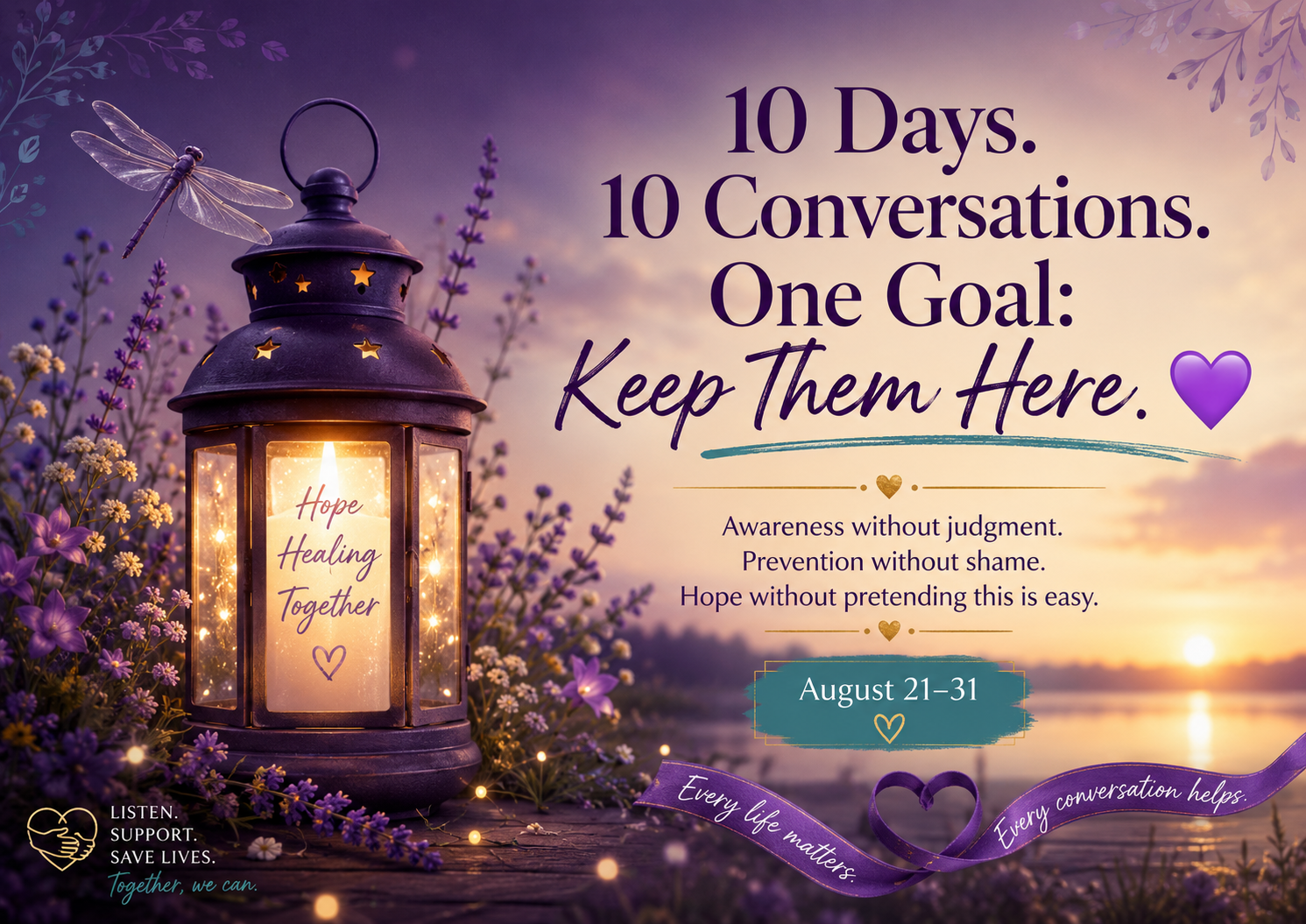
10 Days. 10 Conversations. One Goal: Keep Them Here. 💜
Awareness without judgment.
Prevention without shame.
Hope without pretending this is easy.
And today’s addition:
Understanding without excusing.
Because we can understand how someone got here without pretending that addiction hasn’t caused harm.
We can hold boundaries.
We can expect accountability.
We can protect families.
And still believe:
This human being is worth helping.
Tomorrow — Day 7 💜
What If Help Found People Before They Had to Find Help?
Tomorrow we’re going to talk about what happens after:
The overdose.
The Narcan.
The emergency room.
The desperate 2 a.m. phone call.
The moment somebody finally says:
“Okay. I need help.”
Because sometimes we tell people:
“Get treatment.”
as if treatment is a building with a giant flashing arrow above it.
It isn’t always that simple.
Where do you call?
Who has a bed?
Who accepts your insurance?
Can you get medication for opioid use disorder?
What if you don’t have transportation?
What if you’re discharged from the ER?
What if you’re ready right now but the appointment is next Thursday?
And what happens when the motivation that exists in this moment disappears before help arrives?
Tomorrow we’re going to talk about treatment access, overdose follow-up, medication for opioid use disorder, and one question I think our communities need to take much more seriously:
What if we stopped waiting for people at their lowest point to become expert navigators of an incredibly complicated system? 💜
Sources & Further Reading
National Institute on Drug Abuse (NIDA) — Prevention
NIDA explains that substance-use disorders are chronic, treatable conditions influenced by interacting biological, individual, family, social, and environmental factors. It also outlines risk and protective factors including genetics, early substance use, trauma, mental health, peers, family environment, and chronic stress.
NIDA — Drug Misuse and Addiction
Information about biological and environmental vulnerability to addiction, including the role of genetics, development, family, peers, and drug effects on the brain.
NIDA — Trauma and Stress
Research on the relationship between trauma, stress, and substance-use disorders—including the important point that trauma increases risk but does not inevitably lead to addiction.
NIDA — Co-Occurring Disorders and Health Conditions
Information about the complicated relationship between mental illness, substance use, trauma, stress, pain, and shared risk factors.
NIDA — Medications for Opioid Use Disorder
Current information on opioid use disorder and medications including methadone, buprenorphine, and naltrexone, as well as evidence that medication treatment reduces overdose and mortality risk.
Leave a Reply