
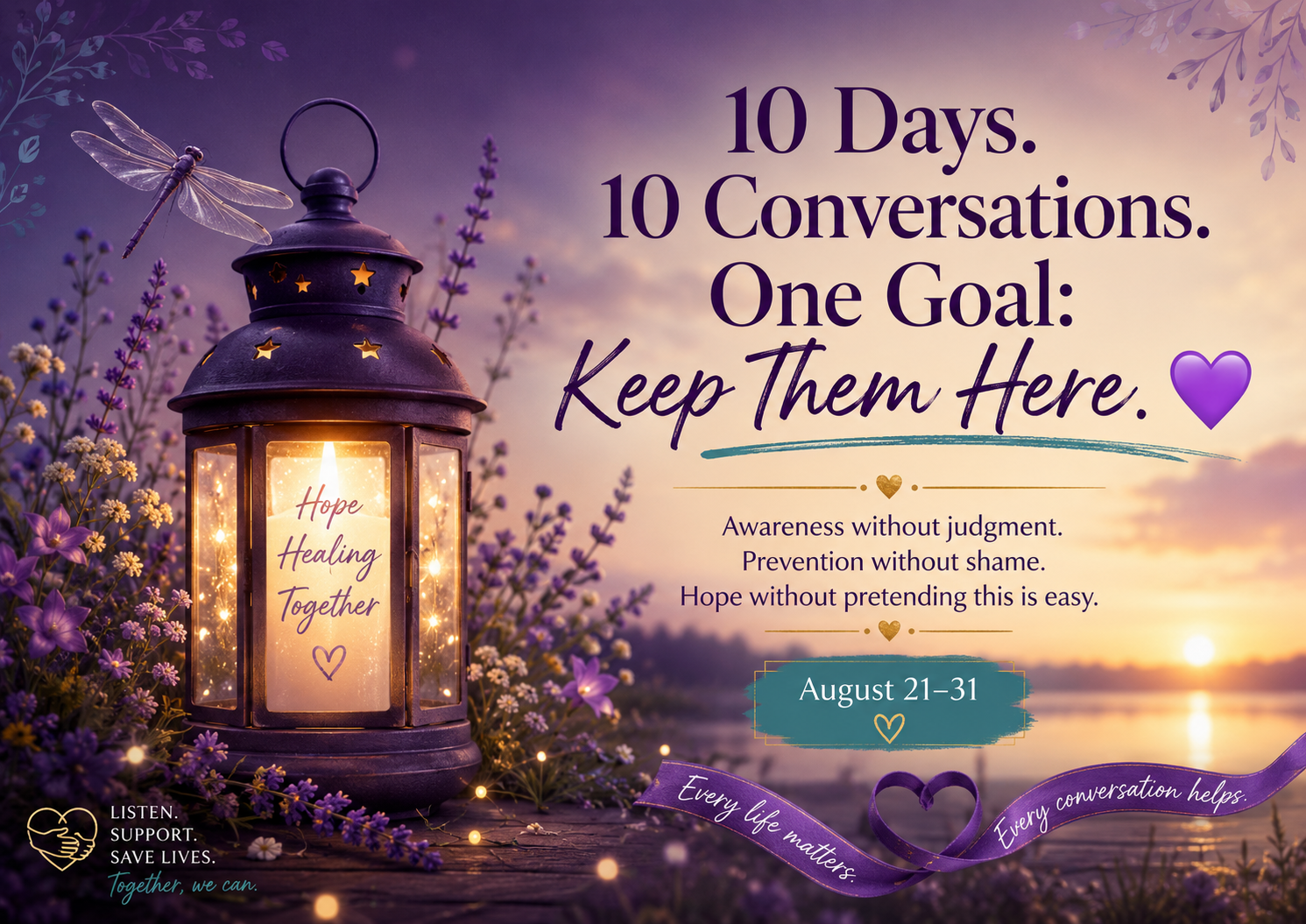
International Overdose Awareness Day — Remembering Them. Fighting for Those Still Here.
Today is August 31.
International Overdose Awareness Day.
And this is our tenth and final conversation.
For ten conversations, we have talked about fentanyl.
We have talked about counterfeit pills—and then corrected ourselves when we realized fentanyl is so much bigger than pills.
We talked about powder.
Smoking.
Foil.
Snorting.
Injecting.
Drugs mixed with fentanyl.
People who unknowingly encounter it.
And people who knowingly use it because addiction and dependence are complicated things.
We talked about Narcan.
Overdose signs.
Our kids.
Addiction.
Treatment.
Families.
Our criminal-justice system.
Portugal.
Shame.
Recovery.
Boundaries.
And hope.
A whole lot of hope.
But today?
I want to come back to the people.
Because none of those conversations matter if we forget who we’re having them for.
25 Years On. Still Needed. 🕯️
The official theme for International Overdose Awareness Day in 2026 is:
25 Years On. Still Needed.
I sat with those words for a while.
Because they’re heartbreaking.
For 25 years, people around the world have gathered on August 31 to remember those lost to overdose, support the people left behind, educate communities, reduce stigma and try to prevent another family from receiving that phone call.
Twenty-five years.
And we still need this day.
We shouldn’t.
We shouldn’t still need mothers standing beside pictures of their children explaining that they were more than the way they died.
We shouldn’t need another candlelight vigil.
Another purple ribbon.
Another memorial walk.
Another photograph with dates underneath it.
Another family learning the language of toxicology reports and coroners and overdose.
But we do.
And as long as we do?
We keep showing up.
Their Name Was Not “Overdose”
This is what I want us to remember most today.
The people we lost had names.
They were not:
The fentanyl death.
The addict.
The overdose.
The drug statistic.
They were somebody’s:
Son.
Daughter.
Mom.
Dad.
Brother.
Sister.
Husband.
Wife.
Best friend.
Grandchild.
Parent.
Person.
They had childhood photographs.
Favorite foods.
Songs that made them turn the radio up.
Bad habits.
Nicknames.
Inside jokes.
Dreams.
People they irritated.
People they adored.
People who adored them.
Some struggled with addiction for years.
Some didn’t.
Some knew exactly what they were using.
Some didn’t know fentanyl was there.
Some had been sober and relapsed.
Some were experimenting.
Some had survived previous overdoses.
Some never got a previous overdose to survive.
Their circumstances were different.
Their humanity was not.
They were here.
Garet Was Here 💜
Before fentanyl became part of my vocabulary in a way I never wanted it to…
Garet was here.
My son was 19.
He was funny.
Kind.
Social.
Caring.
A smart aleck.
And if you knew that grin, you probably knew when he was about to say something he absolutely knew he should probably keep to himself. 😂
He wasn’t a lesson.
He wasn’t a statistic.
He wasn’t the reason for an awareness campaign.
He was my son first.
Always.
January 31, 2022 changed the ending of his story.
But it did not rewrite the nineteen years before it.
Fentanyl does not get to own all of him!!!
I have said versions of that throughout this series, and I mean it more today than ever.
It took enough.
It does not also get his entire identity.
It doesn’t get every memory.
It doesn’t get every story.
It doesn’t get his laugh.
It doesn’t get his personality.
It doesn’t get the people who loved him.
Those belong to us.
Grief Doesn’t Care How Someone Died!
There can be a strange cruelty surrounding overdose loss.
Sometimes bereaved families encounter questions other grieving families never have to answer.
Did they have a drug problem?
Did they know it was fentanyl?
Had they overdosed before?
Were they in treatment?
And underneath some of those questions can be another one:
Were they somehow responsible for dying?
Families hear it.
Even when nobody says it directly.
And it can make grief incredibly lonely.
Because when someone dies from cancer, we generally do not begin by calculating whether they made every perfect health decision throughout their life.
When somebody dies in a car accident, we don’t reduce everything they were to the decisions that occurred in the moments before the crash.
But addiction and overdose still carry a stigma that can somehow make people think grief needs to be justified.
It doesn’t.
A mother does not love her child less because drugs were involved.
A child does not miss their parent less.
A brother doesn’t stop missing his sister.
A spouse’s empty side of the bed is still empty.
Death is still death.
And love is still love.
Some Families Are Carrying Two Stories
There is the story of the person they loved.
And then there is the story of addiction.
Sometimes those stories look almost like two different people.
Families remember:
Who they were before.
Who addiction sometimes turned them into.
And who they occasionally saw again in between.
The funny one.
The kind one.
The person who suddenly looked like themselves again for ten minutes.
Those moments can hurt terribly after someone dies.
Because families are left holding all of it.
The beautiful memories.
The terrible ones.
Anger.
Love.
Relief that the chaos has stopped.
Guilt for feeling that relief.
Grief.
Regret.
Questions.
Sometimes forgiveness.
Sometimes things that were never resolved.
Overdose grief isn’t neat.
Neither is any other grief.
We don’t need to make it neat today.
We can simply make room for it.
And Today Is Also About the People Who Survived
This matters enormously to me.
International Overdose Awareness Day isn’t only about people who died.
The official campaign also focuses on preventing overdose and taking action to save lives. Communities around the world use August 31 for remembrance, education, vigils, harm-reduction efforts and calls for better prevention and care.
So I want to say something to another group today.
If you survived an overdose, I’m glad you’re here!
Let me say that again. Because I mean it.
If you survived an overdose, I’m glad you are here!
Even if it wasn’t your first.
Even if everybody told you it should have been your wake-up call last time.
Even if you went right back to using.
Even if you’ve lost count.
Even if people stopped believing you when you said you were done.
You are here.
That matters.
Maybe today you’re in recovery.
Maybe you aren’t.
Maybe today is six years.
Maybe six months.
Maybe six days.
Maybe six hours.
Maybe you’re reading this while knowing full well you are going to use again tonight.
I still want you alive tomorrow.
Because while you’re alive?
Something can change.
If You Relapsed, You Are Still Here
I wish people understood how dangerous shame can become after relapse.
Someone has been sober.
People are proud.
Relationships begin healing.
Then they use again.
And suddenly they may think:
I blew it.
Everybody is going to be disappointed.
I can’t go back to treatment again.
I’ve already failed too many times.
Please hear this:
A relapse does not require a funeral.
It needs to be taken seriously.
Absolutely.
Especially after a period of abstinence, when lowered opioid tolerance can increase overdose risk.
But if relapse happened and you’re still here?
Get help again.
Carry naloxone.
Tell somebody.
Go back.
Make another appointment.
Start Day 1 again if that is what it takes.
There is no prize for having the neatest recovery story.
The goal is to stay alive long enough to build one.
If You Carry Narcan, Thank You!!
Maybe you’ve never thought about this as something worth being thanked for.
It is.
If you carry naloxone in your purse…
Thank you.
If you put it in your business…
Thank you.
If you learned how to use it…
Thank you.
If you used it on someone once…
Thank you.
If your teenager knows where it is…
Thank you.
If you’re the police officer, firefighter, paramedic, nurse, outreach worker, peer-support specialist or ordinary stranger who has administered it…
Thank you!
You gave someone something priceless.
Time.
What they did with that time afterward may not have been up to you.
But you gave it.
And sometimes another tomorrow is where recovery begins.
If You Work in Addiction Treatment, Thank You!!
Because these are not easy jobs.
Sometimes you meet someone at their absolute worst.
They are angry.
Sick.
Scared.
Withdrawn.
Manipulative.
Ashamed.
Not sure they even want help.
Sometimes they leave.
Sometimes they relapse.
Sometimes they come back.
Sometimes they don’t.
And then sometimes?
Years later, there’s a person standing in front of you whom you barely recognize from that first day.
Healthy.
Working.
Laughing.
Parenting.
Helping somebody else.
Living.
That is why the work matters.
If You Are the Family, I See You Too!!
The person who sleeps with their phone beside the pillow.
The parent who keeps Narcan in the house.
The spouse who stopped believing promises but still wants their person alive.
The sibling who is angry and terrified at the same time.
The grandparent raising children because their parent cannot.
The child who learned far too young what addiction means.
The family member who finally had to say:
“I love you, but I cannot live like this anymore.”
You belong in today’s conversation too.
You deserve support.
You deserve boundaries.
You deserve a life that contains something besides the next crisis.
And if the person you love eventually recovers?
Wonderful.
But you are allowed to begin healing before they do.
What Have These Ten Conversations Actually Taught Us?
Maybe this is the part I most want to carry forward.
We learned that fentanyl doesn’t always look one way.
We learned that counterfeit pills matter—but fentanyl is also sold as powder, smoked, snorted, injected, swallowed and found in other drugs.
We learned that people may knowingly use fentanyl or unknowingly encounter it.
We learned that Narcan does not “enable” an overdose.
It interrupts one.
We learned what overdose can look like.
We learned that strange snoring from someone who cannot be awakened isn’t something to laugh off.
We learned that our kids need conversations before there is a crisis.
Even the “good kids.”
Especially the kids we assume already know.
We learned addiction isn’t simply:
Bad person + bad choice = addiction.
Biology matters.
Genetics matter.
Environment matters.
Mental health matters.
Trauma can matter.
Stress matters.
Access matters.
And choice exists inside a much more complicated human picture than most slogans acknowledge.
We learned that effective treatment exists.
We learned that finding it can still be painfully difficult.
We learned that sometimes the best response isn’t another brochure.
It’s:
“I’ll help you make the call.”
We looked at Portugal and discovered that drug policy is much more complicated than the words legalize, criminalize and decriminalize make it sound.
We learned that public safety and public health do not have to be enemies.
And yesterday, we remembered that families need help too.
Ten conversations.
And somehow almost every one came back to one lesson:
Keep the human being in the middle of the conversation.
Awareness Isn’t Enough If Nothing Changes
There are purple ribbons today.
Candles.
Facebook frames.
Vigils.
Memorial photographs.
People around the world will light landmarks purple, tell stories and say names as part of International Overdose Awareness Day.
I think that’s beautiful.
But tomorrow?
The candle goes out.
The profile picture changes.
September begins.
And interestingly, August 31 leads directly into Recovery Month in September.
That feels incredibly appropriate.
Today:
We remember.
Tomorrow:
We keep working toward recovery!
Because awareness should lead somewhere.
Maybe it leads you to put Narcan in your home.
Maybe you finally talk to your teenager.
Maybe you stop using the word junkie.
Maybe you learn where treatment is available in your community.
Maybe you reach back out to someone in recovery.
Maybe you find support for yourself.
Maybe you change the way you vote on a policy after actually learning what it does.
Maybe you stop seeing somebody on the street as:
“that drug addict.”
and begin wondering:
“What happened here, and what would actually help?”
Awareness is supposed to change what we do next.
Their Deaths Should Teach Us Without Becoming Their Entire Story
This is a difficult balance.
I talk about Garet because maybe what happened to him teaches somebody something.
Maybe another parent has a conversation earlier.
Maybe another kid understands fentanyl differently.
Maybe someone gets Narcan.
Maybe someone recognizes an overdose.
Maybe someone enters treatment.
Maybe somebody stops judging a mother whose child died from drugs.
If something good comes from sharing his story?
I want that.
But Garet did not exist to become a cautionary tale.
Neither did anyone else’s child.
That matters.
Their lives have value completely separate from the lessons we learned because they died.
They didn’t owe us a lesson.
They were people.
And today we honor that.
So Say Their Names 🕯️
Yesterday I asked you to share their names.
Today I’m asking again.
Fill the comments.
Fill your page.
Fill your kitchen table.
Say them quietly if that is all you can manage.
Write:
“Their name was…”
Then tell us something.
Not:
“He was an addict.”
Tell me:
He loved fishing.
Not:
“She overdosed.”
Tell me:
She had the loudest laugh in the room.
Not:
“He died from fentanyl.”
Tell me:
He loved his little sister more than anything.
Tell me about the tattoos.
The music.
The dogs.
The terrible jokes.
The food.
The temper.
The kindness.
The mess.
The ridiculous thing they always did.
Tell me something only someone who loved them would know.
Make them a person again.
Not because they ever stopped being one.
Because sometimes the rest of the world forgot.
Light the Candle 🕯️
Tonight, light one if you want to.
For someone you lost.
For somebody still struggling.
For the person in recovery.
For the family still waiting for the phone to ring.
For the kid who survived last night.
For the person who will encounter fentanyl tonight and doesn’t yet know it.
For the paramedic carrying naloxone.
For the treatment counselor answering another call.
For the mother praying:
Please, God. Just let them come home.
One candle.
One life.
One reminder.
And If You Are the Person We’re Talking About…
Maybe somehow this reaches someone actively using drugs.
Then this part is yours.
I don’t know what happened.
I don’t know what you’ve done.
I don’t know who is angry with you.
I don’t know how many bridges you’ve burned.
I don’t know how many treatment programs you’ve left.
I don’t know whether you’ve overdosed before.
I don’t know whether you’ve lied.
Stolen.
Relapsed.
Disappeared.
I don’t know whether your family still answers.
But I know this:
If you are reading this, you are still here.
That means there is still something left to work with.
You do not need to repair your entire life tonight.
You do not need to solve addiction tonight.
You do not need to convince everyone you’ve changed.
Maybe tonight’s job is much smaller.
Tell someone the truth.
Get naloxone.
Ask about treatment.
Go somewhere safer.
Try again.
Stay.
Please stay.
Because somewhere between the things you regret and the person you could still become is a life that has not happened yet.
You don’t know what is in it.
Neither do I.
But you have to be here to find out.
Love and Light,
~Mandy💜
What Do We Do Now?
This is the question I promised we would end with.
After ten conversations…
What do we do with everything we know now?
We talk.
We teach.
We carry Narcan.
We recognize overdose.
We call 911.
We help people reach treatment.
We challenge shame.
We support families.
We protect children.
We hold boundaries.
We expect accountability.
We keep learning.
We question systems that don’t work.
We support the ones that do.
We remember the dead.
We fight for the living.
And perhaps most importantly:
We stop looking away.
Because this crisis becomes much easier to ignore when everybody affected by it remains invisible.
They aren’t invisible here.
They Were Here. 💜
Garet was here.
Your son was here.
Your daughter was here.
Your brother was here.
Your mother was here.
Your friend was here.
They laughed here.
Loved here.
Made mistakes here.
Made memories here.
Occupied space here.
Changed people here.
They mattered here.
And for those still living with addiction:
You are here.
For those in recovery:
You are here.
For the families:
You are here.
And maybe that is where I want to leave these ten conversations.
Not with fentanyl.
Not with death.
Not even with grief.
With here.
Because here means there is still time.
Here means another conversation.
Another treatment attempt.
Another apology.
Another boundary.
Another birthday.
Another morning.
Another chance.
And whenever possible?
We keep them here.
And when we cannot…
we keep their names, their stories, and the lives they lived here with us.
🕯️💜
Today’s Final Reflection
If you have lost someone:
Their name is __________.
They were more than __________.
Something I want the world to know about them is __________.
If someone you love is still struggling:
One thing addiction has never been able to take from them is __________.
And if you are in recovery:
What is one thing you have today that you once thought you would never have again?
Your answer may be hope for somebody who cannot see their own future yet.
Sources & Further Reading
International Overdose Awareness Day — 2026 Campaign. The official 2026 theme is “25 Years On. Still Needed.” International Overdose Awareness Day is observed every August 31 and focuses on remembrance, overdose prevention, education, action and reducing stigma.
International Overdose Awareness Day — 2026 Events. Communities around the world are marking the day with vigils, purple-lighting events, remembrance activities, education and evidence-based overdose-prevention efforts.
Centers for Disease Control and Prevention — Provisional Overdose Data. CDC’s National Center for Health Statistics continues to update U.S. provisional overdose mortality data monthly; the latest dataset was updated August 12, 2026, reminding us that overdose remains an ongoing public-health issue even as national trends evolve.
Leave a Reply